
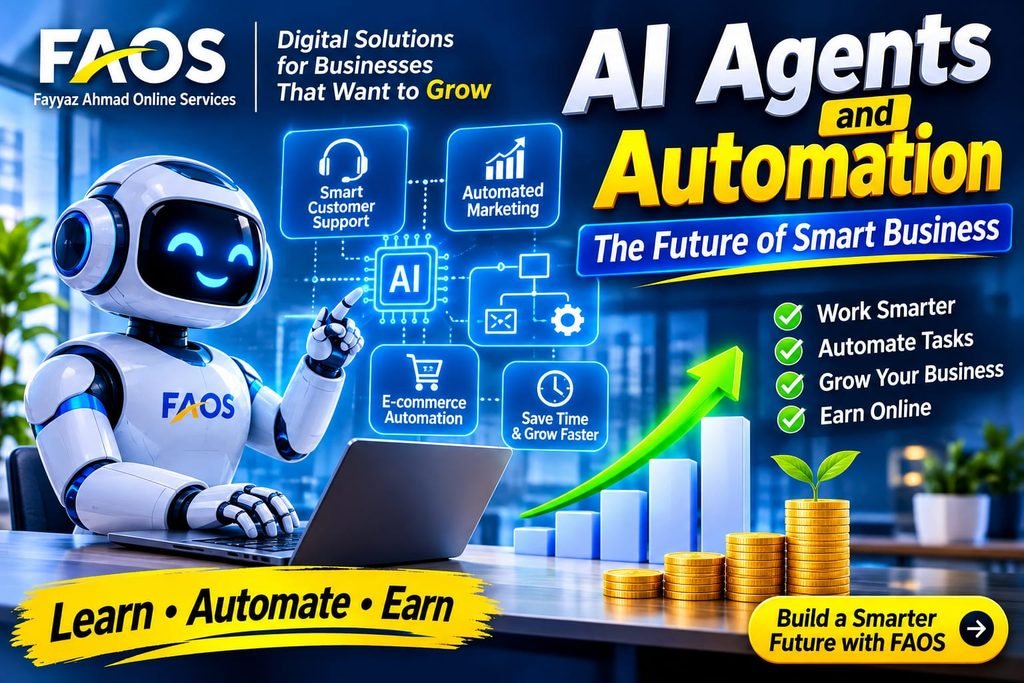
AI Agents and Automation: How to Build a Smarter Business in 2026
AI Agents and Automation: The Future of Smart Business, Online Income and Business Growth
Title: AI Agents and Automation: How to Build a Smarter Business in 2026
Discover how AI agents and automation are transforming businesses, creating online income opportunities, reducing manual work and helping entrepreneurs grow.
AI automation tools, AI agents for business, business process automation, AI-powered business, workflow automation, AI income opportunities, automated digital marketing, future of AI.
A New Era of Working Smarter
Technology has always changed the way people work. The internet created new business opportunities, smartphones connected people around the world, and digital platforms made it possible to earn without owning a traditional office or physical shop.
Now, another major transformation is taking place: Artificial Intelligence (AI), AI agents and automation.
Businesses are no longer limited to completing every task manually. They can use intelligent systems to communicate with customers, organize information, manage workflows, prepare reports, support marketing activities and perform many repetitive operations.
But there is something important to understand: AI is not just about asking questions or generating text. Modern AI systems can also help perform tasks, follow instructions, connect different tools and complete multi-step workflows.
This creates opportunities for business owners, freelancers, students, professionals and entrepreneurs.
The real question is no longer simply whether AI will change the future. The more important question is whether we are learning how to use it effectively.
- What Are AI Agents?
An AI agent is a software-based system that can understand a goal, process information, make decisions within defined boundaries and take actions using connected tools.
Unlike a basic chatbot that mainly responds to questions, an AI agent can be designed to complete a sequence of tasks.
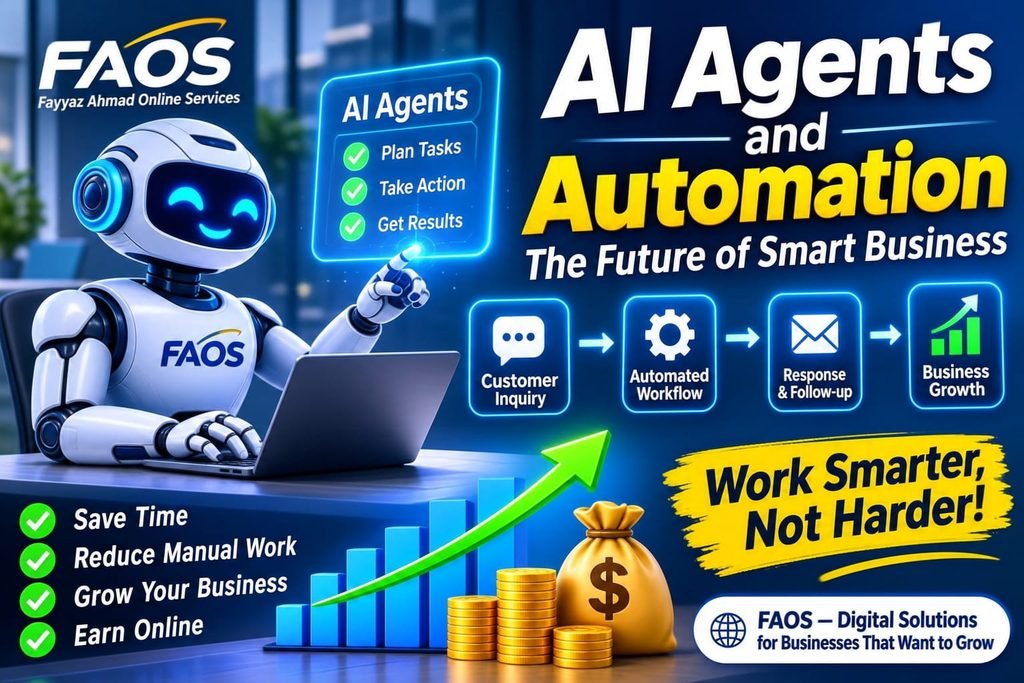
For example, imagine a business receives a customer inquiry through its website.
An AI agent could be configured to:
- Read the customer’s message.
- Identify what service the customer needs.
- Ask relevant follow-up questions.
- Record the information in a CRM.
- Notify the sales team.
- Prepare a suitable response.
- Schedule a follow-up.
These activities can happen through a connected workflow, with human approval added wherever necessary.
An AI agent does not automatically become an expert in every situation. Its performance depends on its instructions, available information, connected tools and permissions.
- What Is Automation?
Automation means using technology to perform repetitive or predefined tasks with minimal manual involvement.
Consider a simple example.
A customer completes a contact form on your website. Instead of manually copying the details into a spreadsheet and sending a confirmation email, an automated workflow can:
- Receive the form submission.
- Save the customer’s details.
- Send a confirmation email.
- Notify the relevant team member.
- Create a follow-up task.
This is business automation.
Automation is particularly useful for tasks that follow predictable rules and happen repeatedly.
- AI Agents vs Traditional Automation
Although these technologies work together, they are not exactly the same.
Traditional Automation
- Follows predefined rules.
- Performs repetitive tasks.
- Works best with structured information.
- Usually follows a fixed sequence.
- Is highly useful for predictable operations.
AI Agents
- Can interpret natural-language instructions.
- Can process less-structured information.
- Can select between permitted tools.
- Can adapt their next step according to available information.
- Can manage more flexible, multi-step tasks.
The smartest approach: Combine both technologies. Use traditional automation for reliable, predictable processes and AI agents for tasks that require interpretation, language understanding or more flexible decisions.
- How AI Agents Can Transform Businesses
Businesses often lose valuable time on activities that do not directly generate revenue.
For example, answering repeated questions, entering customer information, organizing emails, preparing basic reports and following up with potential clients.
AI agents and automation can help reduce this workload.
A. Customer Support Automation
An AI-powered support system can:
- Answer frequently asked questions.
- Explain products and services.
- Guide customers through basic processes.
- Collect customer requirements.
- Forward complicated issues to human staff.
This can improve response times and help businesses remain available outside normal working hours.
B. Sales and Lead Management
Finding potential customers is important, but managing every inquiry manually can become difficult.
An AI-supported lead management system can:
- Collect inquiries from websites.
- Categorize leads according to their requirements.
- Store information in a CRM.
- Prepare personalized follow-up messages.
- Remind sales teams about pending conversations.
Human sales professionals can then focus on important conversations and closing deals.
C. Digital Marketing Automation
Marketing involves several activities, including content planning, campaign management, audience research and performance analysis.
AI tools can support these activities by helping businesses:
- Generate content ideas.
- Prepare social media drafts.
- Organize publishing schedules.
- Analyze campaign reports.
- Identify possible improvements.
- Prepare marketing performance summaries.
AI should support marketing decisions, not replace proper strategy, audience understanding and professional judgment.
D. E-commerce Automation
Online stores can use automation to improve their daily operations.
Examples include:
- Order notifications.
- Customer support.
- Product information management.
- Inventory alerts.
- Shipping updates.
- Customer feedback collection.
Some activities require integration with the store’s platform, payment system, inventory software or delivery provider.
E. Administrative and Office Work
AI agents can also support everyday office operations.
They can help organize documents, summarize information, prepare reports, classify emails and create task reminders.
This allows employees and business owners to spend more time on planning, customer relationships and business development.
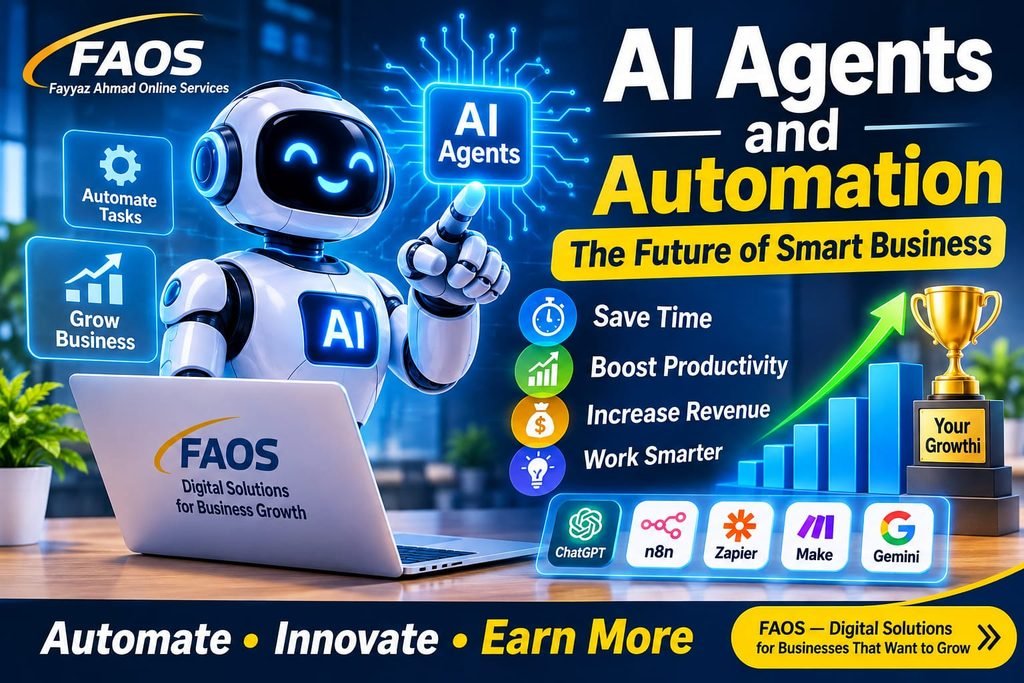
- Popular Tools for AI Agents and Automation
There are many tools available, each designed for different requirements.
Here are some important platforms worth exploring.
ChatGPT
Useful for research, writing, planning, analysis, content creation and AI-assisted workflows. Depending on the available features and integrations, it can also support more advanced agent-based tasks.
Claude
Useful for working with long documents, writing, analysis, research assistance and structured problem-solving.
n8n
A workflow automation platform that connects different applications and services. It is useful for creating customized workflows and integrating AI models.
Make
A visual automation platform that helps connect applications and build workflows without requiring extensive programming knowledge.
Zapier
Useful for connecting business applications and automating repetitive activities through predefined triggers and actions.
Google Gemini
Useful for AI-assisted research, productivity and working with Google’s ecosystem and supported integrations.
Microsoft Power Automate
Useful for automating business processes and connecting Microsoft applications and other supported services.
Important: These tools are not interchangeable. The best choice depends on the business problem, technical requirements, budget, integrations and level of control needed.
- How People Can Earn Through AI Agents and Automation
One of the most exciting opportunities is that AI automation is not limited to large technology companies.
Individuals and small businesses can also develop useful services.
Here are some potential earning opportunities.
- AI Automation Freelancer
Businesses need help connecting applications and reducing repetitive work.
Freelancers can offer services such as:
- Automated email workflows.
- Customer inquiry management.
- CRM integrations.
- Lead collection systems.
- Automated reporting.
- AI-powered business workflows.
- AI Chatbot Development
Many businesses want automated customer support on their websites.
You can learn how to create chatbots that answer common questions, collect information and transfer complicated requests to human representatives.
- AI Content and Marketing Services
You can help businesses organize content production, social media workflows, marketing research and campaign reporting.
The value comes from delivering useful, accurate and professionally reviewed work rather than simply generating large quantities of AI content.
- Business Automation Consultant
Some businesses do not know which tasks should be automated.
A consultant can study their existing processes, identify repetitive activities, recommend suitable tools and implement practical solutions.
- AI Workflow Development
More advanced freelancers can build connected systems that combine AI models, databases, business applications and automation platforms.
This requires technical knowledge, testing and an understanding of how different applications communicate.
- Which Skills Should You Learn?
You do not need to become an advanced programmer before starting.
However, you should build your knowledge step by step.
Beginner Level
- Understanding AI and automation.
- Writing effective AI instructions.
- Using AI productivity tools.
- Understanding basic business workflows.
- Working with spreadsheets and online forms.
Intermediate Level
- Learning n8n, Make or Zapier.
- Connecting applications.
- Creating automated email workflows.
- Understanding APIs and webhooks.
- Building basic AI chatbots.
- Working with CRM systems.
Advanced Level
- Building AI agents.
- Working with APIs and databases.
- Understanding authentication and permissions.
- Creating multi-agent workflows.
- Developing custom automation solutions.
- Testing, monitoring and securing automated systems.
The most valuable combination is technical knowledge, problem-solving ability and an understanding of real business needs.
- A Practical Example: Automating a Small Business
Imagine a digital services company receiving 50 customer inquiries every day.
Without automation, employees may need to read each message, categorize it, record contact details and assign follow-up tasks.
Now imagine a connected workflow:
- A customer submits an inquiry.
- An AI system identifies the service category.
- The customer’s details are saved in a CRM.
- An automatic confirmation is sent.
- The relevant team receives a notification.
- A follow-up task is created.
- A human employee reviews important inquiries and handles negotiations.
The company can organize its leads more efficiently and reduce repetitive administrative work.
However, sensitive decisions, financial commitments, refunds and important customer promises should have suitable human approval.
- Challenges and Risks You Should Understand
AI automation creates opportunities, but using it without proper planning can also create problems.
Incorrect information: AI systems can produce inaccurate answers. Important information should be verified.
Data privacy: Customer information must be handled carefully. Only necessary data should be shared with tools that are authorized to process it.
Security: Connected applications should use secure authentication and limited permissions.
Unexpected actions: Automated workflows can send incorrect messages or update the wrong records if they are poorly configured.
Overdependence: Businesses should retain human supervision and a way to stop or correct automated processes.
Implementation costs: Some platforms require paid subscriptions, API usage or technical maintenance.
A successful automation system is not simply one that works automatically. It is one that works reliably, securely and produces measurable value.
- Your 30-Day Learning Roadmap
If you want to enter this field, start with a practical learning plan.
Week 1 — Understand the Basics
Learn what AI agents, automation, APIs, workflows and integrations mean. Explore ChatGPT and other AI tools.
Week 2 — Learn Workflow Automation
Choose one platform, such as n8n, Make or Zapier. Learn triggers, actions, conditions and application connections.
Week 3 — Build Practical Projects
Create three small projects:
- Automated website inquiry collection.
- AI-assisted customer support.
- Automated email notification and follow-up.
Test each project with sample data before using real customer information.
Week 4 — Build Your Portfolio
Document your projects, explain the problems they solve and create demonstrations.
You can then approach small businesses, offer freelance services or use these systems to improve your own business operations.
Remember that 30 days is a starting roadmap, not a guarantee of professional mastery or income.
- The Future: Businesses That Work Smarter
The future of business will not necessarily belong to companies with the largest teams or the biggest offices.
Businesses that understand technology, customer needs and efficient processes can gain important advantages.
AI agents will continue developing. Automation platforms will become more accessible, and integrations between business applications will create new possibilities.
But technology alone does not guarantee success.
A business still needs a valuable product or service, customer trust, good management, effective communication and a clear strategy.
The opportunity belongs to people who learn how to combine human intelligence with technological capabilities.
- How FAOS Can Help Businesses Adopt AI and Automation
At FAOS (Fayyaz Ahmad Online Services), we believe technology should solve real business problems.
Our approach is to understand how a business currently operates, identify areas where digital solutions can improve efficiency and recommend practical technology.
Depending on business requirements, this may include:
- Website and digital platform development.
- AI-assisted business solutions.
- Workflow and process automation.
- CRM and customer management solutions.
- Digital marketing and social media support.
- E-commerce and online business solutions.
Our objective is not to introduce technology simply because it is popular. It is to help businesses select solutions that support their actual goals.
Whether you are a small business owner, an entrepreneur, a freelancer or someone beginning a digital career, learning AI agents and automation can open new opportunities.
Final Thoughts
AI agents and automation are changing the way businesses operate and how individuals deliver professional services.
You can use these technologies to save time, organize work, improve customer experiences and develop new digital skills.
Start small. Learn one platform. Solve one real problem. Build one working project. Then improve it.
Do not focus only on the number of AI tools available. Focus on what you can create with them and how much value your work can deliver.
Learn the technology. Understand the problem. Build the solution. Create value.
FAOS — Digital Solutions for Businesses That Want to Grow.