
By Fayyaz Ahmad Online Services — Smart Solutions. Reliable Service.
Introduction: Why Most “Make Money Online” Advice Lets You Down
Open any social media app and within thirty seconds someone is promising you a laptop lifestyle, a passive-income empire, or a secret system that pays you while you sleep. Most of it is noise. Some of it is outright fraud. And a small part of it, the part that never gets a flashy thumbnail, is real, repeatable, and refreshingly ordinary.
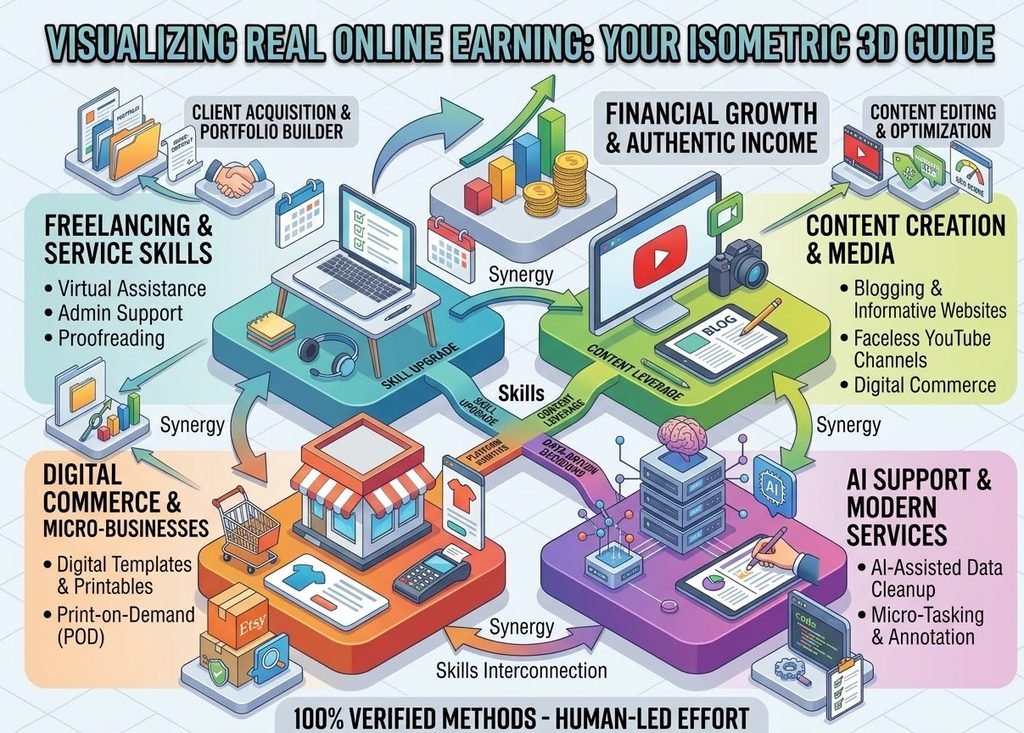
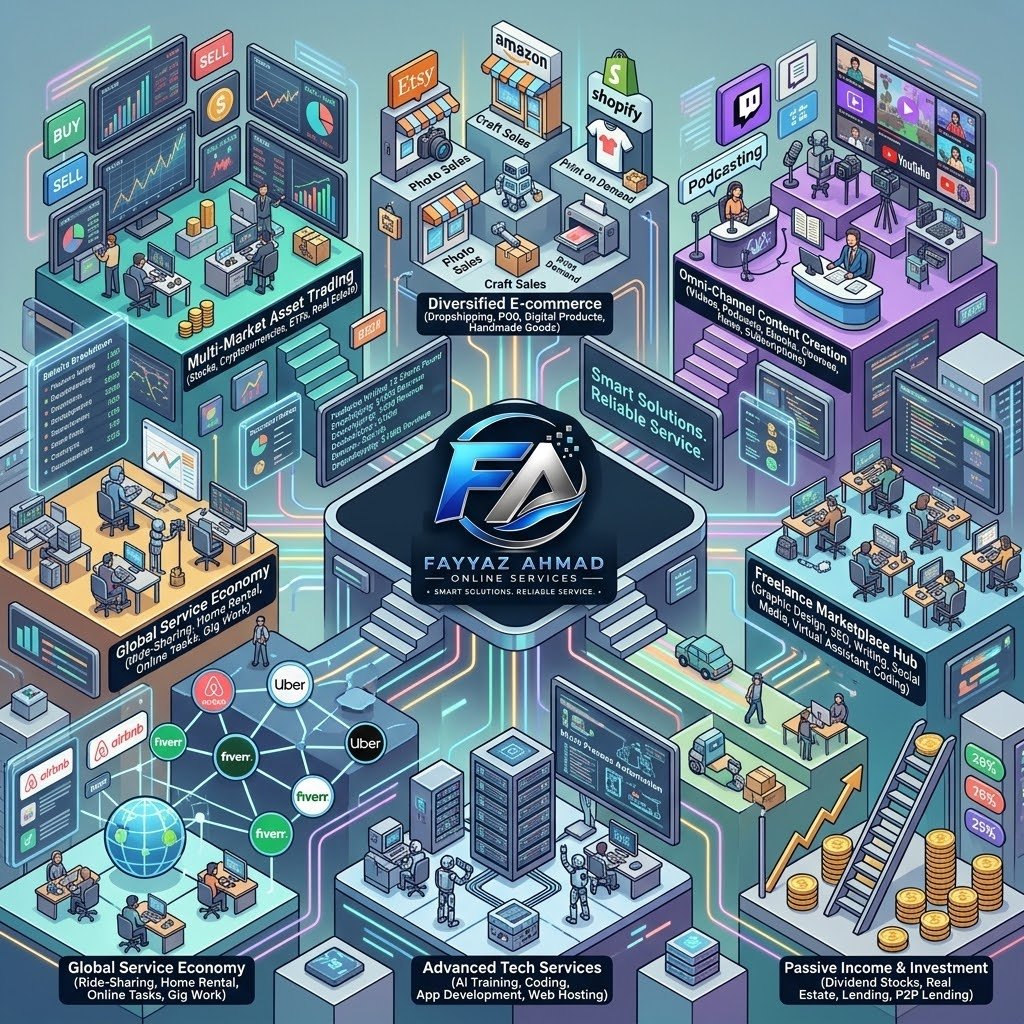
This guide is built around two visual maps. The first is an isometric 3D guide called Visualizing Real Online Earning. It organizes legitimate online income into four connected platforms: Freelancing & Service Skills, Content Creation & Media, Digital Commerce & Micro-Businesses, and AI Support & Modern Services. Its footer carries a promise I want to keep throughout this article: verified methods, human-led effort. The second map zooms out into a seven-branch ecosystem covering asset trading, e-commerce, content creation, freelancing, tech services, the global gig economy, and passive investing, all connected to one hub built on the idea of smart solutions and reliable service.
Think of the first map as your foundation and the second as your horizon. The foundation is where most beginners should spend their first six to twelve months. The horizon is where you can grow once you have skills, savings, and a track record.
One honesty note before we begin. Nothing here is a guarantee of income, and nothing here is financial advice. Your results will depend on your skills, your country, your consistency, and some plain luck. What I can promise is clarity: by the end you will know what each income stream involves, what it costs in time and money, and how the streams strengthen each other. Let’s walk through the map.
How to Read the Map: Skills, Synergy, Income
The first thing you notice in the isometric guide is that the four platforms are not islands. They are joined by glowing bridges labeled Skill Upgrade, Content Leverage, Platform Authority, and Data-Driven Decisioning, with the word Skills sitting right at the crossing point. Every platform also has a Synergy arrow pointing toward its neighbors. At the top of the image, rising bars and stacks of gold coins sit under the heading Financial Growth & Authentic Income.
That layout is the entire philosophy in one picture. Income is not the starting point; it is the outcome. The starting point is skills, and the skills sit at the center. Every platform on the map is simply a different way of putting those skills in front of paying people.
Here is how I read the diagram, from the middle outward:
• Skills are the crossroads. Writing, organizing, research, communication, basic design, and digital literacy are portable. They work on every platform.
• Platforms are delivery vehicles. A freelance marketplace, a blog, an Etsy shop, and a data-annotation platform are different roads to different customers.
• Synergy is the multiplier. A freelancer who also blogs finds clients faster. A shop owner who learns data cleanup makes better product decisions.
• Growth is the result. The rising bars and coins appear only after the other three are working.
If you take one idea from this article, take this one: stop asking “Which method pays the most?” and start asking “Which skill can I build that works on more than one platform?” With that in mind, let’s go quadrant by quadrant.
Platform One: Freelancing & Service Skills
In the upper left of the first map, a laptop with a checklist sits beside a headset and a notepad. Nearby, a folder and a handshake carry the caption Client Acquisition & Portfolio Builder. The three skills listed, Virtual Assistance, Admin Support, and Proofreading, are deliberately unglamorous. They are also among the most consistently needed services online.
Virtual Assistance
A virtual assistant takes tasks off a busy person’s plate: managing email, scheduling meetings, organizing files, updating spreadsheets, preparing simple reports, or answering customer messages. Coaches, small business owners, and online sellers hire virtual assistants because their own time is worth more than the tasks themselves. You need a reliable internet connection, good communication, and comfort with tools like Google Workspace, Trello, or Notion. A degree is not required.
Admin Support
Admin support leans toward structured, repeatable work such as data entry, document formatting, invoice tracking, transcription, and basic bookkeeping support. The defining quality is accuracy. A careful, dependable person tends to keep clients for years.
Proofreading
Proofreading is the quiet hero of the map. Authors, students, bloggers, and companies all need clean text, and AI writing tools have not removed that need; they have increased the volume of text that needs a human eye. A good proofreader catches grammar slips, inconsistent style, contradictions, and awkward phrasing. If you read carefully and enjoy language, this is a low-cost entry point.
Client Acquisition & Portfolio Builder
Skills without clients are just hobbies, which is why the image gives this call-out its own spot. A simple approach:
1. Build three sample projects. For example, a tidy inbox workflow, a before-and-after proofread article, and a sample weekly schedule for an imaginary client.
2. Write a clear profile. One sentence on who you help, one on how, and one on why you are reliable.
3. Start on marketplaces. Platforms like Upwork and Fiverr give you built-in traffic while you collect your first reviews.
4. Ask for testimonials after every successful job.
5. Raise your rates gradually once you have a handful of good reviews.
Be realistic: the first few weeks are often slow. Freelancing is still the fastest platform on the map to produce a first payment, because you are selling your time directly rather than waiting for traffic to arrive.
Platform Two: Content Creation & Media
The upper right of the map is its brightest zone: a large monitor with a play button, a camera, a tablet showing a blog draft, and a small panel titled Content Editing & Optimization with video thumbnails, tags, and an SEO score gauge. The listed paths are Blogging & Informative Websites, Faceless YouTube Channels, and Digital Commerce, which tells you that content and commerce overlap.
Blogging & Informative Websites
A blog earns when it attracts readers who have a need and then meets that need better than other pages do. Income can come from display ads, affiliate links, sponsored posts, your own digital products, or from using the blog as a showcase that wins freelance clients. The honest part: blogging is slow. Search engines take time to trust a new site, and most blogs need months of steady publishing before traffic becomes meaningful.
What works is unglamorous. Choose a narrow topic you can serve with real experience. Research what people actually search for. Write complete, helpful answers instead of thin pages. Update older posts as things change. Informative websites win when they are genuinely useful: comparison guides, step-by-step tutorials, local information, and explanations of complicated subjects in simple language.
Faceless YouTube Channels
Faceless means you do not appear on camera. Channels use screen recordings, slides, licensed footage, animation, or voice-over narration. Popular formats include tutorials, explainers, list videos, and educational summaries. The advantage is privacy and scalability. The challenge is that YouTube is crowded, and viewers quickly spot low-effort, mass-produced videos. The platform has also been tightening its rules on repetitive or inauthentic content, so originality in your script, your insight, and your editing matters more than ever. Monetization requires meeting YouTube’s eligibility thresholds, which change over time, so check the official help pages before you plan around them.
Content Editing & Optimization
The small panel in the corner is easy to overlook, but it is where amateurs become professionals. Editing a video for pacing, writing titles and tags that match what viewers search for, checking an SEO score, tightening a blog introduction, and improving thumbnails are the skills that make the same raw content perform noticeably better. They are also sellable services: many creators pay editors, thumbnail designers, and SEO helpers.
Digital Commerce Inside Content
Notice that Digital Commerce appears in this quadrant too. Creators often earn most when they sell templates, e-books, presets, or mini-courses to an audience they have already built. A helpful blog post can end with a related product. This is Content Leverage in action: one piece of content attracts readers, builds trust, and sells something, all at once.
Platform Three: Digital Commerce & Micro-Businesses
The lower-left platform is dominated by a striped-awning shop, a shopping cart, a phone showing a T-shirt, a card reader, and packages marked with the Etsy name and a magnifying glass. Two paths are listed: Digital Templates & Printables, and Print-on-Demand (POD).
Digital Templates & Printables
Planners, budget trackers, resume templates, social media templates, classroom worksheets, and Notion dashboards are all examples. You create the product once, and customers download it every time they buy, with no shipping and no inventory. The catch is competition. Thousands of sellers offer similar files, so success comes from solving a specific problem for a specific buyer, such as a budget planner for freelancers with irregular income rather than a generic planner.
Practical steps: study best-selling listings to see what buyers want; design with beginner-friendly tools such as Canva; write titles and descriptions using the phrases buyers actually search for; and create attractive preview images. Always make sure you own or have licensed every font, graphic, and image you use.
Print-on-Demand (POD)
With print-on-demand, a supplier prints and ships products such as shirts, mugs, tote bags, and posters only after a customer orders. You upload designs; the supplier handles production and delivery. That lowers upfront risk, but margins can be thin and quality depends on your partner, so order samples before you sell. Designs must be original or properly licensed. Copying trademarked characters or slogans can get your shop closed.
The Micro-Business Mindset
The word micro-business is a helpful reminder that a small shop is still a business. It needs a niche, a recognizable brand, good customer service, basic bookkeeping, and awareness of the tax rules in your country. Treat it that way from day one and you will be ahead of most beginners.
Platform Four: AI Support & Modern Services
The lower-right platform is purple, with server racks, a glowing brain, a hand editing a document on a tablet, a code window, and an AI chip. It lists two services: AI-Assisted Data Cleanup and Micro-Tasking & Annotation. This is the newest part of the map and the one most likely to change quickly.
AI-Assisted Data Cleanup
Businesses collect messy data: duplicate customer records, inconsistent spellings, missing fields, and spreadsheets stitched together from several sources. A person who can use spreadsheet tools and AI assistants to clean, standardize, and check that data, and who verifies the result by hand, provides real value. The key phrase in the map’s footer is human-led. AI can speed the work up, but wrong entries and privacy slips are still your responsibility. The professional is the one who reviews.
Micro-Tasking & Annotation
Micro-tasking means completing small online tasks: labeling images, rating search results, checking text for accuracy, or tagging audio. Annotation work helps train and evaluate AI systems. Pay per task is usually modest, so think of it as flexible supplementary income and a window into how AI systems are built, not a full-time replacement for a job. Stick to well-known platforms, never pay to unlock tasks, and read the payment terms before you start.
Why This Platform Matters to Everyone
Even if you never do annotation for a living, learning to work with AI makes you better at everything else on the map: writing clear instructions, checking outputs, and protecting sensitive information. A freelancer who drafts faster, a blogger who researches deeper, and a shop owner who analyzes sales are all using the same skill, which is directing technology with human judgment.
Synergy: Where One Plus One Becomes Three
Now return to the bridges between platforms. They are the most valuable part of the guide.
• Skill Upgrade: Every client project teaches you something you can write about, film, or turn into a template. A virtual assistant who masters spreadsheet automation can publish tutorials. A proofreader can write a guide to common grammar mistakes.
• Content Leverage: Your blog or channel is free advertising for your products. A reader who trusts your budgeting advice is far more likely to buy your budgeting template.
• Platform Authority: As your shop grows, your reviews, ratings, and brand recognition become assets you can build on, including by advising other sellers.
• Data-Driven Decisioning: Analytics, keyword research, and simple testing turn guesses into decisions. Creators who read their numbers improve faster.
Imagine a fictional beginner named Ayesha. In months one to three she proofreads for small clients on a freelancing marketplace. In month four she starts a small blog about common mistakes in business emails, using examples from her work. By month six she sells a printable editing checklist as a digital template. By month nine she uses simple spreadsheet analysis, with AI assistance and careful checking, to see which posts and listings attract the most visitors, then does more of what works. Four platforms, one skill set, each feeding the next. That is the map in motion.
Zoom Out: The Seven-Branch Income Ecosystem
The second map is busier and more ambitious. At its center sits a glowing hub carrying the Fayyaz Ahmad Online Services mark and the tagline Smart Solutions. Reliable Service. Around it, staircases and glowing data lines connect seven districts, from trading desks and online storefronts to studios, freelance offices, server rooms, and a staircase of coins.
Treat these seven districts as the next level. Some require capital. Some require advanced skills. Some carry real financial risk. Let’s take them one at a time, starting with the ones closest to what you already know.
Freelance Marketplace Hub
Graphic design, SEO, writing, social media management, virtual assistance, and coding fill this office floor. It is the expanded version of Platform One. Marketplaces connect you with global clients, but long-term growth usually means moving toward direct clients. Specialize, because an SEO writer for dental clinics beats a generic writer. Package your services into fixed-price bundles. Offer monthly retainers, such as social media management, for predictable income. Watch platform fees and keep communication professional.
Diversified E-Commerce
Dropshipping, print-on-demand, digital products, and handmade goods all appear here, with storefront icons for Etsy, Amazon, and Shopify, plus photo sales and craft sales. Each model has different economics:
• Dropshipping: no inventory, but you own customer service, ad costs, and supplier reliability. Margins can be thin, so test supplier quality and shipping times yourself.
• Print-on-demand and digital products: low upfront cost, high competition, covered earlier.
• Handmade goods and craft sales: better margins and a story customers like, but limited by your production time.
• Photo sales: stock photography and prints reward consistency and technical quality, though each image earns little.
Marketplaces such as Etsy and Amazon bring built-in traffic but charge fees and set rules. A Shopify store gives you control and a real brand, but you must bring your own visitors. Spreading across channels reduces the risk of one platform suspending your account overnight.
Omni-Channel Content Creation
Videos, podcasts, e-books, courses, news, and subscriptions surround a studio with a podcast desk, cameras, and screens showing YouTube and Twitch. The big idea is omni-channel: create once, then repurpose. A long video becomes a podcast episode, a blog post, a handful of short clips, and a newsletter. Subscriptions and memberships add recurring revenue from your most loyal fans. The trap is spreading too thin, so pick one flagship channel first and add others only when it runs smoothly.
Advanced Tech Services
AI training, coding, app development, and web hosting sit in the server room, with a screen labeled for process automation. Barriers are higher here, and so are rates. Realistic starting points include building websites for local businesses, writing small automation scripts, creating simple mobile apps, reselling managed hosting, and expert-level AI evaluation work. Learn through projects. The market pays for solved problems, not certificates, so build a few working examples you can show.
Global Service Economy
Ride-sharing, home rental, online tasks, and gig work appear here, with Uber, Airbnb, and Fiverr nodes linked around a globe. This district turns assets and spare hours into cash flow. A car can earn through ride-sharing, a spare room through home rental, and a free evening through online tasks. The details depend heavily on your country, because platform availability, licensing rules, insurance requirements, and taxes differ widely. Read the local regulations before you invest in a vehicle or a property.
Also calculate the real numbers. Fuel, maintenance, platform commissions, cleaning, and depreciation can shrink what looks like a healthy income. Treat gig work as flexible cash flow that can fund your bigger goals, not as a complete career plan by itself.
Multi-Market Asset Trading
The top-left district is full of buy and sell screens covering stocks, cryptocurrencies, ETFs, and real estate. It is also the district where I want to slow down the most, because this is the one part of both maps where you can lose the money you put in. Please read this section as education, not advice, and speak to a licensed professional in your country before committing real money.
• Most short-term traders struggle. Research on retail day traders in several countries has found that many lose money over time once costs are counted.
• Never trade with borrowed money, or with money you need for rent, food, or school fees.
• Start with education and tiny amounts. Practice accounts let you learn the mechanics without risking capital.
• Know what you hold. Broad, low-cost ETFs are simpler than picking individual stocks, cryptocurrencies can swing wildly in days, and real estate is hard to sell quickly.
• Use regulated platforms and be suspicious of anyone selling trading signals, guaranteed returns, or auto-trading bots.
• Learn the tax rules for gains in your country before you start, not after.
Trading is a skill and a risk, not a shortcut. Many people are better served by steady saving and long-term investing than by chasing quick wins.
Passive Income & Investment
The lower-right staircase climbs through stacks of coins and percentage tags to represent dividend stocks, real estate, lending, and peer-to-peer lending. It is the dream scene of the whole map: money that works while you sleep.
The reality is that passive income is usually the late chapter of a story that began with active income. You earn, you save, you invest, and then you wait, often for years. Each stream carries its own risks. Dividends can be reduced or cancelled. Rental property brings vacancies, repairs, and difficult tenants. Lending and peer-to-peer lending carry default risk and platform risk, and the rules vary by country. A very high advertised yield is usually a warning sign, not a bargain. The percentages in the image are illustrative; no number is promised to anyone.
Build this district last, with money you can afford to leave untouched, and spread it across several holdings rather than one.
Your 90-Day Starter Roadmap
You do not need to do everything on both maps. You need to do one thing well, then connect it to a second. Here is a simple plan, assuming roughly ten to fifteen hours a week.
Days 1 to 30: Choose and prepare
• Pick one skill from Platform One or Platform Two, such as proofreading, virtual assistance, or blogging.
• Spend the first two weeks learning the basics through free tutorials and practice projects.
• Build three portfolio samples and set up a clean profile on one marketplace or a simple one-page website.
• Open a separate account for business money so you can track earnings clearly.
Days 31 to 60: Pitch and publish
• Send a few tailored proposals or pitches every day and keep a simple log of the results.
• Deliver your first jobs early and politely request reviews.
• Start a weekly content habit, even one useful post or video about what you are learning.
Days 61 to 90: Improve and connect
• Raise your prices slightly and let go of low-quality clients.
• Turn your best lesson into a small digital product, such as a checklist or template.
• Review your numbers: which proposals won, which posts got visitors, and how many hours each income stream took.
• Move a fixed share of earnings into savings before spending the rest.
At day 90 you will not be rich, but you will have a skill, a portfolio, a few reviews, and a system. That is more than most people who only watch videos about it.
Red Flags: How to Avoid Online Earning Scams
The same internet that offers real opportunities is full of traps. Walk away if you see any of these:
• Fees to start working. Genuine employers do not charge you to unlock jobs or training.
• Guaranteed returns. Anything promising fixed profits from trading, lending, or crypto is a major warning sign.
• Overpayment tricks. A client sends too much money and asks you to refund the difference before the original payment clears.
• Moving off-platform. Clients who push you to leave the marketplace’s messaging and payment system remove your protection.
• Screenshot-heavy courses. Income screenshots are easy to fake. Look for verifiable results and honest refund terms.
• Requests for sensitive data. Never share passwords, one-time codes, or banking PINs with anyone, for any reason.
• Recruitment-based income. If earning depends mostly on signing up other people, it is probably a pyramid structure.
Protect yourself by using platform escrow and written agreements, researching companies independently, and trusting your instincts when something feels rushed.
A Realistic View of Earnings
Online income grows in phases. The first phase is learning, where you earn little or nothing. The second is proving, where you accept modest pay to collect reviews and results. The third is stabilizing, where repeat clients, search traffic, or returning customers make income more predictable. Only then comes scaling, where you raise prices, add products, or build a small team.
Most people quit during the first two phases, which is exactly why the third feels rare. Consistency beats intensity. Ten focused hours every week for six months will usually outperform a frantic burst of effort followed by silence. Keep records, pay the taxes you owe, and avoid burning out, because a sustainable pace is the real competitive advantage.
Frequently Asked Questions
Can I start with no money? Yes. Freelancing, proofreading, virtual assistance, micro-tasks, and blogging on a free platform can start with a basic device and an internet connection. Shops, tools, and advertising cost money later.
Which method should I pick first? The one that matches a skill you already have and gives you feedback fastest. For most beginners, that means freelancing.
How much can I earn? Anyone who gives you a precise number without knowing your skills, country, and effort is guessing or selling something. Expect a modest, slow start and growth as your experience grows.
Will AI take these jobs? Some tasks will change or disappear, and others will grow. People who combine human judgment, accuracy, and smart use of AI tools are better placed than those who ignore either.
Do I need to show my face? No. Blogging, faceless YouTube, digital products, and many freelancing roles can be done without ever appearing on camera.
Conclusion: Build the Foundation, Then Expand the Horizon
Both maps tell the same story in different ways. The first shows that real online income grows from skills, flows through connected platforms, and rewards verified methods and human-led effort. The second shows how far that can stretch once you have the experience and capital to explore more advanced districts, from e-commerce and content empires to tech services and investing.
The path is not glamorous, but it is clear. Choose one skill. Build a small portfolio. Land your first client or publish your first useful page. Connect a second platform. Track your numbers. Protect yourself from scams and from overconfidence. Then repeat, a little better each time.
Online earning is not a secret. It is a craft, and like any craft it rewards patience, honesty, and steady practice. Start where you are, use what you have, and let the synergy do its quiet work.
Disclaimer: This article is for educational purposes only. It is not financial, legal, or tax advice, and it does not guarantee any income. Always do your own research and consult a qualified professional before making financial decisions.