
How to Reach the Right Customers and Grow Your Business
Are You Promoting Your Business but Still Struggling to Get Customers?
Running a business takes time, money, patience, and hard work. Whether you own a local shop, a service company, an online store, or a growing business, you want people to know about your products and services.
But getting noticed is not always easy.
You may have created a Facebook page, posted pictures of your products, or even spent money on advertisements. Perhaps some people liked your posts, but very few contacted you. Maybe you received clicks on your website without getting any sales. You might even have hired someone to manage your marketing but struggled to understand where your money was going.
If any of this sounds familiar, you are not alone.
Many business owners face the same challenges. They know that online marketing is important, but they are unsure which platform to choose, how much to spend, or how to identify the right customers.
This is where Google Ads and Social Media Marketing (SMM) can help when they are planned and managed properly.
Google Ads can help your business appear in front of people searching for products or services like yours. Social media marketing can help you build relationships, introduce your brand, share useful information, and stay connected with potential customers.
Both approaches have different strengths. Neither guarantees success on its own. The real opportunity comes from understanding your audience, setting clear goals, choosing the right strategy, and measuring the results.
At Fayyaz Ahmad Online Services (FAOS), our aim is to help businesses understand their digital marketing options and choose solutions that suit their needs.
In this guide, we will explain how Google Ads and SMM work, why businesses sometimes struggle with online advertising, how to avoid common mistakes, and how to build a practical marketing strategy without wasting money unnecessarily.
Whether your customers are in Pakistan, the United States, the United Kingdom, or another market, the principles discussed here can help you make better marketing decisions.
—
1. What Is Google Ads?
Google Ads is Google’s online advertising platform. It allows businesses to create paid campaigns that can reach potential customers through eligible Google advertising placements.
Depending on the campaign type, advertisements may appear in Google Search results, on YouTube, on relevant websites, in shopping placements, or across other supported advertising surfaces.
One of the most useful features of search advertising is that it can reach people who are actively looking for something.
For example, imagine you own a web design company.
Someone searches Google for “website designer for small business.” If your campaign is appropriately configured, your advertisement may appear when that person searches.
This is different from showing an advertisement to someone who may have no immediate interest in your service.
How does Google Ads work?
A typical Google Ads campaign involves several important steps:
1. You choose a business objective, such as generating enquiries, receiving calls, or selling products.
2. You identify the audience, locations, and advertising placements relevant to your business.
3. You prepare an advertisement that clearly explains your offer.
4. You establish a budget and appropriate bidding settings.
5. You direct interested people to a relevant website page, product listing, or contact method.
6. You measure the results and improve the campaign over time.
The actual setup depends on the campaign type.
Some campaigns involve keyword targeting, while others use audience signals, product feeds, or automated targeting. The most suitable option depends on your business and the customers you want to reach.
Why do businesses use Google Ads?
Google Ads can be useful when a business wants to reach potential customers who are already looking for a product or service.
For example:
– A plumber may want to reach people searching for plumbing services in a particular city.
– An online retailer may want to promote specific products.
– A marketing agency may want to attract businesses searching for digital marketing support.
– A training company may want to generate enquiries for a course.
– A local service provider may want to encourage phone calls or appointment bookings.
The important point is that the advertisement should match the customer’s needs.
If your business provides website development, an advertisement about website development should lead to a page that explains that service—not an unrelated page that forces visitors to search for the information themselves.
—
2. What Is Social Media Marketing (SMM)?
Social Media Marketing, commonly known as SMM, involves using social platforms to promote a business, communicate with customers, build brand awareness, and generate relevant enquiries or sales.
Depending on your audience and business model, suitable platforms may include Facebook, Instagram, LinkedIn, TikTok, YouTube, and others.
Social media marketing includes both organic and paid activities.
Organic social media marketing involves publishing content and interacting with people without paying for each advertisement placement.
Paid social media marketing involves paying a platform to distribute advertisements to selected audiences.
Both approaches can be valuable, but they serve slightly different purposes.
Organic social media marketing
Organic content helps people learn about your business over time.
You might share:
– Product photographs and demonstrations.
– Helpful advice related to your industry.
– Answers to common customer questions.
– Information about your services.
– Business updates and announcements.
– Genuine customer feedback, with appropriate permission.
– Short videos explaining how your products or services work.
Useful content gives potential customers a reason to pay attention to your business.
However, publishing content does not guarantee that every follower will see it. Platform algorithms, audience behaviour, competition, and content quality can affect how widely your posts are distributed.
Paid social media advertising
Paid campaigns can help you reach selected audiences based on the targeting options available on a platform.
For example, a clothing retailer may want to show product advertisements to people in a particular location. A business-to-business company may prefer a platform such as LinkedIn to reach professionals.
Campaign objectives can include awareness, website visits, enquiries, app activity, or purchases, depending on the platform and setup.
The key is to choose an objective that reflects what you actually want customers to do.
If you want sales, measuring only likes and views will not tell you whether the campaign is profitable.
—
3. Google Ads vs Social Media Marketing: Which Is Better?
Business owners often ask which option is better.
The honest answer is that neither is automatically the best choice for every business.
Google Ads is often useful for reaching people who are actively searching for a solution. Social media can be particularly useful for introducing a business, demonstrating products, building relationships, and creating demand.
Consider the following comparison.
Feature| Google Ads| Social Media Marketing
Main opportunity| Reach relevant searches and other selected audiences| Build awareness, engagement, and customer relationships
Customer intent| Search campaigns can capture existing demand| Can introduce products before customers actively search
Content| Search text, product assets, videos, and other formats| Posts, images, videos, stories, and paid advertisements
Useful measurements| Conversions, qualified leads, cost per lead, sales| Reach, engagement, leads, purchases, and cost per result
Budget| Depends on competition, targeting, bidding, and market| Depends on platform, audience, content, and campaign objective
Main challenge| Attracting relevant clicks that convert into valuable actions| Reaching the right audience and turning attention into business results
When should you consider Google Ads?
Google Ads may be a good option when:
– Customers already search for your product or service.
– You want to generate enquiries for a specific service.
– You have a clear offer and a suitable landing page.
– You can respond to enquiries promptly.
– You can measure the value of a lead or sale.
When should you consider SMM?
Social media marketing may be a good option when:
– Customers discover products through images or videos.
– You want to build awareness of a new brand.
– You need to explain your services to an audience.
– Your business benefits from regular customer interaction.
– You want to develop a community around your brand.
Can you use both?
Yes. In many situations, a combination makes sense.
For example, Google Ads may help people find your service when they are searching for it, while social media content helps them understand your expertise and become familiar with your brand.
The two channels can support the same business goal, but you should not assume that every business needs both immediately.
Start with the channel that best addresses your main problem. Add another channel when your budget, resources, and results justify doing so.
—
4. Why Do Google Ads Campaigns Sometimes Fail?
Spending money on advertising can be stressful, especially for small businesses.
You may see impressions and clicks in your campaign report but receive few enquiries. This can make it difficult to know whether the campaign is working.
The problem is not always the advertising platform itself. Often, one or more parts of the campaign need improvement.
Wrong keyword targeting
Imagine you offer professional website development but your campaign attracts people searching for free website-building tutorials.
Those visitors may be interested in learning rather than hiring a service provider.
Although the searches are related, they may not represent your intended customers.
A good search campaign requires careful consideration of the terms people use when looking for a service.
Depending on the campaign, you may also need negative keywords to exclude irrelevant searches.
Poor advertisement messaging
An advertisement should tell people what you offer and why it may be relevant to them.
If the message is vague, people may not understand what happens when they click.
Instead of simply saying “Best Digital Services,” a more useful advertisement might explain that you provide website design and digital marketing support for small businesses.
Any claims about experience, results, pricing, or guarantees should be accurate and supportable.
An unsuitable landing page
A landing page is the page a person reaches after clicking an advertisement.
If the advertisement promises information about a specific service but the destination contains unrelated information, visitors may leave without contacting you.
A good landing page should answer the visitor’s main questions, explain the offer, build confidence, and provide a clear next step.
That next step might be submitting an enquiry, requesting a quotation, calling your business, or purchasing a product.
Slow response to enquiries
Generating a lead is only one part of the process.
If a potential customer submits a form but receives no reply, the opportunity may be lost.
Make sure someone is responsible for checking enquiries, responding within a reasonable period, and following up appropriately.
No conversion tracking
Without appropriate tracking, it can be difficult to understand which advertisements generate valuable actions.
Clicks alone do not reveal whether customers completed a purchase or submitted a useful enquiry.
Where appropriate and permitted, configure conversion tracking and verify that it works correctly.
For privacy-sensitive implementations, consider applicable consent requirements and platform policies.
Spending without reviewing results
A campaign should be monitored against its objective.
If the data shows that particular searches or advertisements are attracting irrelevant visitors, investigate and make changes.
Do not continue spending simply because the campaign is already running.
A successful campaign is not the one that receives the most clicks. It is the one that helps achieve a meaningful business objective at a cost your business can justify.
—
5. Why Social Media Marketing Sometimes Produces No Sales
Social media can create attention, but attention does not automatically become revenue.
A business might have thousands of followers yet receive very few enquiries. Another business might have a small audience but attract customers who genuinely need its services.
Several factors can explain the difference.
Content that does not match the audience
If your audience is interested in practical business advice, repeatedly publishing unrelated promotional graphics may not help.
Understand what your customers care about and create content that addresses their questions, problems, and interests.
No clear call to action
A post may explain your service but leave readers unsure what to do next.
A clear call to action can invite interested people to request a quotation, visit your website, ask a question, or view your products.
Avoid overwhelming people with too many competing instructions.
Inconsistent communication
Publishing several posts in one day and then disappearing for weeks can make it harder to maintain a consistent presence.
Choose a realistic schedule that you can sustain.
Consistency does not mean posting constantly. It means communicating regularly with useful, relevant information.
Poor-quality enquiries
A campaign may generate many messages from people who cannot afford your service or do not need what you offer.
Review the audience, advertisement, offer, and wording.
Sometimes a more specific message attracts fewer enquiries but a higher proportion of suitable potential customers.
Ignoring customer questions
When people comment or send messages, they may be looking for information before deciding whether to buy.
Respond professionally, provide accurate answers, and explain the next steps.
If a question requires more time, let the person know when you expect to respond.
Depending entirely on follower counts
Followers can be useful, but they are not the same as paying customers.
For a service business, qualified enquiries may be more valuable than a large audience. For an online store, purchases and repeat customer activity may matter more than post likes.
Choose measurements that reflect the actual purpose of your marketing.
—
6. How Much Should a Business Spend on Google Ads?
There is no universal advertising budget.
The appropriate amount depends on your industry, location, competition, customer value, campaign objective, and ability to fulfil additional demand.
A local business with a limited service area has different needs from an international online retailer.
The safest approach is to begin with a budget you can afford to test and establish clear rules for evaluating performance.
Understand your total advertising cost
When planning a Google Ads campaign, consider the following expenses:
– Money paid to Google for advertising.
– The cost of campaign setup and management, if outsourced.
– Website or landing-page improvements.
– Creative or copywriting work, where required.
– Conversion tracking and reporting.
– Staff time spent handling enquiries.
The total cost of marketing is more than the amount displayed in the advertising account.
Example: A simple campaign budget
Suppose a business allocates a hypothetical budget of $300 to test a campaign.
If the campaign generates 30 relevant enquiries, the advertising cost per enquiry would be $10, before management fees and other expenses.
However, not every enquiry will become a customer.
If only five enquiries become paying customers, the advertising cost per acquired customer would be $60, before other relevant expenses.
These figures are examples for explanation only, not typical or promised campaign results.
The business would need to compare the cost with its profit margins and the value of the customers acquired.
Set a testing period
Before launching, agree on how much money will be used for the initial test and what information you want to learn.
You may need to test different messages, keywords, audiences, or landing pages.
Do not assume a campaign has failed solely because it did not generate immediate sales. Equally, do not keep funding a campaign indefinitely without evidence of progress.
Protect your budget
Use appropriate account settings, review spending regularly, and understand how the campaign’s budget is applied.
If you hire an agency, clarify who controls the advertising account and who pays the platform.
You should be able to see the actual advertising expenditure rather than relying entirely on a service provider’s summary.
—
7. How to Plan a Social Media Marketing Budget
Social media marketing can involve different types of spending.
You may pay for content creation, graphic design, video production, account management, paid advertisements, or influencer collaborations.
Your budget should reflect your business objectives rather than an arbitrary number of posts.
Separate content costs from advertising costs
Suppose you hire someone to prepare social media content and manage your page.
That service fee is different from the money you pay a platform to distribute advertisements.
Ask for a clear breakdown of both.
This makes it easier to understand how much you are spending on content and how much on paid reach.
Start with the most relevant platform
You do not need to advertise everywhere.
Choose the platform that is most appropriate for your audience and the way your products or services are discovered.
A visually focused product business may benefit from Instagram or Facebook. A professional business-to-business service may find LinkedIn more suitable. A business with useful demonstration videos may benefit from YouTube or other video platforms.
These are starting points, not fixed rules. Research your customers before committing a large budget.
Test one objective at a time
A campaign designed to increase awareness may produce different results from one designed to generate sales.
Decide what success means before launching.
For example, a local service business may prioritise qualified enquiries. A new brand may first need relevant people to discover its products.
Review performance according to that objective.
Consider the value of your content
Organic content can support paid campaigns by explaining your offer and building familiarity with your brand.
A potential customer may see an advertisement, visit your profile, read a useful post, and then contact you.
This is one reason a consistent and informative social media presence can be valuable even when you are paying for advertising.
—
8. How to Find the Right Customers for Your Business
One of the most important decisions in digital marketing is identifying who you want to reach.
Trying to sell to everyone can make your message too broad.
A clearer audience helps you choose suitable advertisements, content, locations, and offers.
Define your ideal customer
Consider the following questions:
– What problem does your product or service solve?
– Who is most likely to need it?
– Where are those customers located?
– What budget might they have?
– What questions do they ask before buying?
– What would make them choose your business over another option?
You do not need to know every detail about a customer. You need enough information to make informed marketing decisions.
Choose locations carefully
If you operate a local business, advertising across an entire country may waste money if you can only serve customers within a small area.
Choose geographic targeting that matches your actual service capacity.
If you are targeting customers in the UK or USA from Pakistan, consider whether you can provide the necessary support, delivery, payment options, and communication arrangements.
Do not target an international market simply because it seems attractive. Make sure your business can serve it properly.
Understand customer intent
Different people may search for similar terms for different reasons.
Someone searching for “what is Google Ads” may want to learn. Someone searching for “Google Ads management service” may be looking to hire a provider.
Understanding these differences can help you build more relevant campaigns.
Use evidence rather than assumptions
Review customer enquiries, website data, sales records, and campaign reports.
If a particular audience consistently generates relevant enquiries, investigate why.
If another audience produces clicks but no meaningful actions, review whether the targeting or offer needs improvement.
The purpose of targeting is not to make your audience as large as possible. It is to reach people who are more likely to value what you provide.
—
9. How to Turn Clicks and Engagement into Customers
Attracting attention is only the beginning.
After someone clicks an advertisement or visits your social media profile, the next step should be clear and straightforward.
Explain your offer clearly
Customers should understand what you provide, who it is for, and how to take the next step.
Avoid forcing visitors to interpret vague claims or search through unrelated pages.
Build confidence with accurate information
Provide genuine business details, relevant examples of your work, clear contact information, and realistic explanations of your service.
If you publish testimonials, use authentic customer feedback and obtain permission where appropriate.
Do not invent reviews or promise outcomes that cannot be guaranteed.
Reduce unnecessary steps
If your goal is to generate enquiries, make it easy for interested people to contact you.
A simple form, a clear phone number, or a suitable messaging option may be enough.
Ask for the information you genuinely need rather than making the form unnecessarily long.
Follow up professionally
A person who contacts your business may not be ready to buy immediately.
Answer their questions, explain the options, and give them the information needed to make a decision.
Follow-up should be helpful rather than aggressive. Respect requests not to receive further marketing communications.
Improve the whole customer journey
If people click but do not enquire, investigate the landing page and offer.
If people enquire but do not buy, review response times, pricing, communication, and customer fit.
If customers buy once but never return, examine the product or service experience.
Each stage provides information that can help you improve your marketing.
—
10. Google Ads and SMM for Small Businesses
Small businesses often have limited budgets and limited time.
They cannot afford to spend months experimenting without understanding what they are trying to achieve.
A practical marketing plan should focus on a few important activities that support the business.
Local shops and service providers
A local business might begin by improving its Google Business Profile, building a simple website, and creating a small number of relevant service pages.
If customers actively search for its services, a carefully targeted Google Search campaign may be worth testing.
Social media can support the strategy by sharing updates, answering common questions, and showing genuine examples of the work.
E-commerce businesses
An online store may benefit from product-focused campaigns, suitable shopping advertising, and social media content that demonstrates the products.
Before spending heavily, check product availability, product descriptions, checkout functionality, shipping arrangements, and customer support.
Marketing cannot compensate for an unreliable buying experience.
Professional service businesses
A consultant, agency, or specialist service provider may benefit from informative website pages, useful professional content, and targeted search campaigns.
The aim should be to attract enquiries from people who understand the service and are likely to need it.
New businesses
A new business may need to establish its identity before investing heavily in advertising.
Start by explaining the offer, preparing accurate business information, and identifying the audience.
A small, well-defined campaign may provide useful information about customer interest, but early results should be interpreted carefully.
Established companies
An established business may already have customer data, repeat sales, and a recognisable brand.
Its marketing strategy can build on that foundation by improving conversion tracking, testing new channels, and identifying opportunities to attract and retain customers.
The best approach depends on the business’s current position rather than its size alone.
—
11. How FAOS Can Support Your Digital Marketing
At Fayyaz Ahmad Online Services, we understand that business owners need more than advertisements that look attractive.
They need a clear strategy, suitable digital tools, relevant communication, and a practical way to evaluate performance.
Our digital services can support businesses looking to establish or improve their online presence.
Google Ads campaign support
Businesses considering paid search or other Google advertising formats may need help planning campaigns, developing suitable advertisements, selecting appropriate targeting settings, and monitoring results.
The scope of work should be agreed in advance and aligned with the business objective.
Social media marketing
Social media support can include content planning, graphic design, page management, campaign preparation, and other agreed activities.
The objective is to help businesses communicate consistently and reach relevant audiences.
Digital content and creative design
Clear content and appropriate creative assets can help customers understand your offer.
Depending on the project, this may include promotional graphics, social media content, campaign messaging, and website content.
Website and landing-page development
Advertising works best when interested visitors arrive at a relevant destination.
A well-structured website or landing page can explain your offer, answer common questions, and provide a clear way to contact your business.
SEO and long-term visibility
Search engine optimisation can support a broader digital strategy by improving website content and helping relevant users discover your business through search.
SEO is different from paid advertising and usually requires a longer-term approach.
Analytics and reporting
Businesses need to understand what their marketing is achieving.
Where suitable tracking is available, campaign reports can help evaluate traffic, enquiries, conversions, and costs.
Reports should explain the results in plain language and distinguish measurable outcomes from assumptions.
Business automation and CRM
Marketing can generate enquiries, but those enquiries still need to be managed.
CRM and workflow systems can help businesses organise leads, record follow-ups, and reduce the chance of missing potential customers.
The most useful system is one that supports your actual workflow.
A practical approach
Not every business needs every service.
We encourage business owners to identify their main challenge and discuss the options that fit their objectives, resources, and budget.
The goal is to make informed marketing decisions—not to spend more money than necessary.
—
12. How to Recognise a Trustworthy Digital Marketing Agency
Choosing a marketing provider is a serious decision because advertising involves both money and your business reputation.
Before hiring anyone, take time to understand how they work.
Ask for a clear scope of work
The agreement should explain which platforms and services are included, what deliverables you will receive, and how progress will be reported.
For example, clarify whether the fee covers campaign management only or includes advertising expenditure.
Ask who owns the advertising account
Where possible, your business should retain ownership and administrative control of its important accounts.
A provider can receive the access needed to manage campaigns without unnecessarily taking permanent ownership of your business assets.
Ask how success will be measured
A provider should be able to explain the intended campaign objective and the measurements that will be used.
For a lead-generation campaign, these might include qualified enquiries and cost per lead. For an online store, completed purchases and relevant revenue measurements may be more useful.
Be careful with guarantees
No responsible provider can guarantee every advertising campaign will produce a fixed number of sales regardless of the market, offer, budget, and customer experience.
Be cautious of promises of instant success, guaranteed rankings, or unusually large returns without a clear explanation.
Expect understandable reporting
You should be able to see what was spent, what activities were completed, and what results were recorded.
If a report contains technical terminology, ask for an explanation.
Your marketing should not remain a mystery simply because someone else manages it.
Compare value, not just price
A lower management fee may be attractive, but it is important to understand the quality and scope of the work.
Similarly, a higher fee does not automatically mean better results.
Choose a provider based on suitability, transparency, relevant experience, and the working relationship.
—
13. A Simple 30-Day Google Ads and SMM Plan
A structured first month can help you organise your marketing without trying to do everything at once.
This plan is an example. The appropriate schedule will depend on your business and available resources.
Week 1: Research and preparation
Identify your target customers, the products or services you want to promote, and the main problem your marketing should solve.
Review your website, social media profiles, contact details, and customer enquiry process.
Prepare a realistic budget and decide how you will measure progress.
If you are hiring a provider, agree on the scope of work and account ownership before the campaign begins.
Week 2: Create the campaign foundation
Prepare the relevant landing page, advertisements, social media content, and contact process.
For Google Search campaigns, research relevant search terms and consider which searches may be unsuitable.
For social media, prepare content that explains your offer and gives customers a reason to engage.
Where appropriate, configure and test conversion tracking before relying on the reports.
Week 3: Launch and monitor
Launch the agreed campaign within the planned budget.
Monitor delivery, spending, relevant clicks, enquiries, and any technical problems.
Avoid making major decisions based on every small change in performance. Some campaigns need time and sufficient data before meaningful conclusions can be drawn.
However, investigate obvious problems promptly, such as broken links, incorrect information, or irrelevant traffic.
Week 4: Review and improve
Compare the results with the original objective.
Which advertisements attracted relevant visitors? Which enquiries appeared suitable? Did people complete the intended action? Were there problems with the website or response process?
Use the findings to identify changes.
Depending on the evidence, you might improve the advertisement, refine targeting, adjust the landing page, or pause an ineffective activity.
The first month should provide a foundation for learning and better decisions, not an unrealistic promise of immediate business transformation.
—
14. Common Digital Marketing Mistakes to Avoid
Before investing in Google Ads or SMM, keep these common mistakes in mind.
Mistake 1: Advertising without a clear objective. Decide whether you want enquiries, purchases, bookings, or awareness before launching.
Mistake 2: Targeting everyone. Focus on the customers most likely to value your product or service.
Mistake 3: Sending visitors to an unsuitable page. Match the landing page to the advertisement and make the next step clear.
Mistake 4: Measuring only clicks and likes. Review the actions that matter to your business.
Mistake 5: Spending without a budget limit. Establish spending controls and review costs regularly.
Mistake 6: Expecting immediate results. Allow a reasonable period for testing while responding quickly to clear problems.
Mistake 7: Ignoring enquiries. Make sure someone is responsible for responding to potential customers.
Mistake 8: Using misleading claims. Keep advertisements, prices, testimonials, and service descriptions accurate.
Mistake 9: Ignoring customer privacy. Follow applicable privacy requirements and platform policies when collecting or using customer information.
Mistake 10: Never reviewing the strategy. Use campaign evidence and customer feedback to improve your approach.
Mistake 11: Depending on one platform for everything. Where practical, maintain control of your website, customer information, and essential business accounts.
Mistake 12: Buying services you do not need. Choose digital solutions according to your actual business goals.
—
15. The Future of Digital Marketing: Better Decisions, Not Just More Advertising
Digital marketing continues to develop as platforms introduce new tools, automation features, and ways to measure performance.
Artificial intelligence can help with certain tasks, such as drafting content, analysing information, organising campaign ideas, or identifying patterns in data.
However, these tools do not replace business judgement.
Automated recommendations can be wrong, tracking data may be incomplete, and a campaign that performs well according to one metric may not be profitable overall.
Human oversight remains important.
Businesses still need to understand their customers, communicate honestly, protect their information, and deliver a reliable service.
The most useful technology is technology that helps solve a genuine problem.
For one business, that may mean better campaign reporting. For another, it may mean a clearer website, a more organised enquiry process, or a CRM that helps staff follow up with potential customers.
The future is not simply about spending more money on advertising. It is about using information, creativity, and technology to make better decisions.
—
Conclusion: Reach the Right People with the Right Strategy
Google Ads and Social Media Marketing can provide valuable opportunities for businesses that want to reach new customers and strengthen their online presence.
Google Ads can help connect your business with people searching for relevant products and services. Social media marketing can help introduce your brand, demonstrate your value, and build relationships with potential customers.
But the platform is only one part of the picture.
A strong marketing strategy also requires a clear offer, suitable targeting, an effective landing page, reliable customer communication, realistic budgeting, and meaningful performance measurement.
You do not need to spend a large amount of money to begin making better decisions.
Start by identifying your main business challenge. Understand your customers. Choose a suitable marketing channel. Set a budget you can afford. Track meaningful results and improve your approach based on evidence.
If you are uncertain about where to begin, take the time to understand your options before making a commitment.
At Fayyaz Ahmad Online Services (FAOS), we aim to help businesses explore practical digital solutions, including Google Ads campaigns, social media marketing, website development, SEO, graphic design, and business automation.
Our goal is to help you understand how these services may support your business and which options are appropriate for your needs.
Your business deserves a marketing strategy built around real objectives, clear communication, and informed decisions.
Ready to Discuss Your Digital Marketing Goals?
Contact Fayyaz Ahmad Online Services to discuss your requirements and explore suitable digital marketing options.
Fayyaz Ahmad Online Services (FAOS)
– Website: https://faospk.com
– Phone / WhatsApp: +92 300 6992606
– Location: Allahabad Road, Opposite Animal Mandi Gate, Burewala, Pakistan
Whether you want to attract relevant enquiries, promote products, improve your online presence, or understand how paid advertising could support your business, the first step is a clear conversation about your goals.
Google Ads • Social Media Marketing • Digital Growth
Fayyaz Ahmad Online Services — Smart Solutions, Global Reach.
—
SEO Details for Publishing
SEO Title: Google Ads & Social Media Marketing: A Practical Guide for Business Growth
Suggested URL Slug: “/google-ads-social-media-marketing-guide/”
Meta Description: Learn how Google Ads and social media marketing can help your business reach the right customers, manage advertising costs, generate leads, and grow online with FAOS.
Primary Keyword: Google Ads and Social Media Marketing
Secondary Keywords:
– Google Ads campaign management
– Social media marketing services
– SMM for small businesses
– Google advertising for businesses
– Digital marketing agency
– Online advertising strategy
– Lead generation campaigns
– Facebook and Instagram advertising
– Social media advertising
– Google Ads budget planning
– Digital marketing services in Pakistan
– Digital marketing for UK businesses
– Digital marketing for US businesses
– Website traffic and lead generation
– Business growth through digital marketing
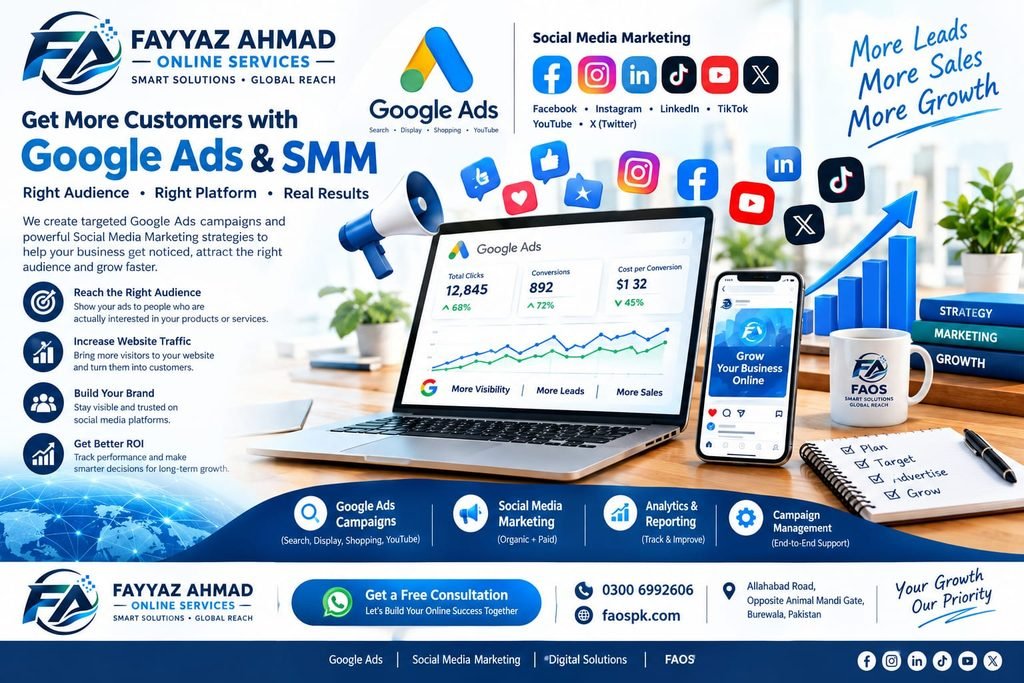
Suggested Featured Image Alt Text: FAOS digital marketing services featuring Google Ads campaigns, social media marketing, campaign analytics, lead generation, and business growth.
Suggested Call-to-Action Button: Discuss Your Marketing Goals
Suggested Social Media Caption:
Are you spending money on online advertising but struggling to get the results you want?
Discover how Google Ads and Social Media Marketing can help your business reach relevant customers, generate enquiries, build brand awareness, and make better marketing decisions.
Our new guide explains the differences between Google Ads and SMM, common advertising mistakes, budget planning, customer trust, and practical ways to improve your campaigns.
Read the blog and take the next step towards a more organised digital marketing strategy.
Fayyaz Ahmad Online Services (FAOS)
Website: https://faospk.com
WhatsApp: +92 300 6992606
Smart Solutions. Global Reach.