
How to Turn Your Skills into Real Income
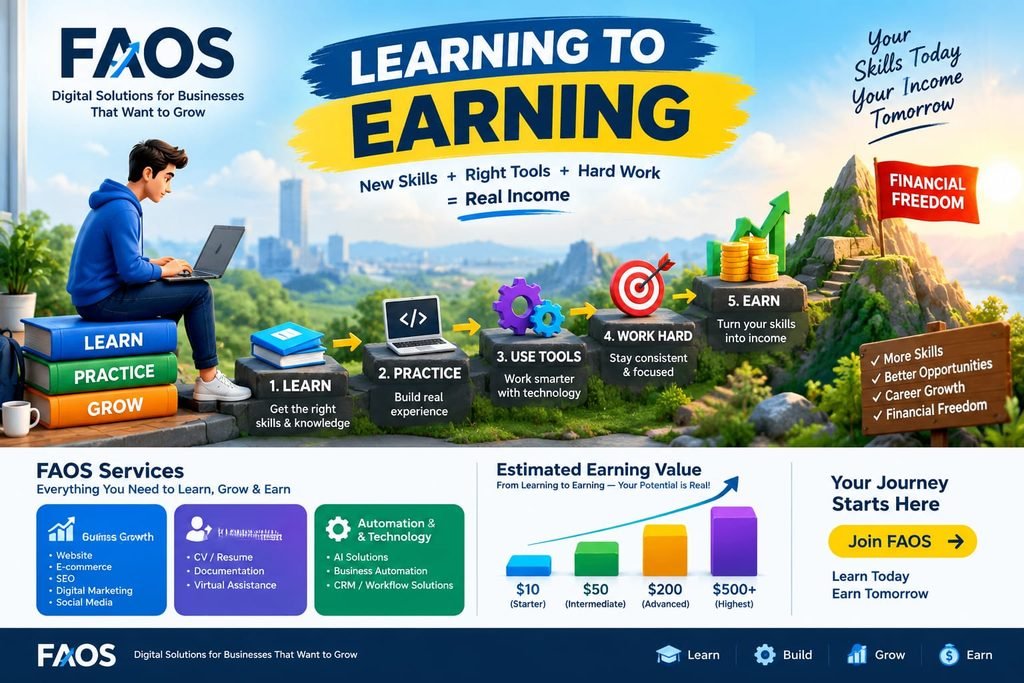
Learn a Skill. Build Your Experience. Create Your Opportunity.
ave you ever wondered how people earn money online while working from home? Perhaps you have seen freelancers working with international clients, people building websites, or small business owners selling their products through the internet.
You may have thought, “Can I do this too?”
The honest answer is yes, it is possible. However, earning online is not magic, and success does not happen overnight. It takes learning, practice, patience, and the ability to solve real problems for other people.
At FAOS, we believe that learning becomes more valuable when you know how to apply it. The right knowledge, combined with practical experience and consistent effort, can open doors to new career and business opportunities.
This guide explains how to move from learning a skill to earning from it, even if you are starting with limited experience.
1. Start with a Skill That People Need
The first step is not finding money. It is understanding what you can learn and what other people need.
Every successful business solves a problem. A shop needs customers. A company needs a website. A professional needs a strong CV. A business owner may need help managing social media or organising daily tasks.
These needs create opportunities for people with the right skills.
Some useful skills to explore include:
– Website development: Build websites for businesses, professionals, and online shops.
– Graphic design: Create social media posts, advertisements, banners, and brand materials.
– Digital marketing: Help businesses reach the right audience through online channels.
– Search engine optimisation (SEO): Improve website content and structure so people can find relevant information through search engines.
– Social media management: Plan content, communicate with audiences, and help businesses maintain an online presence.
– Virtual assistance: Support clients with research, documentation, scheduling, and administrative tasks.
– AI tools and automation: Help people save time by improving repetitive workflows.
– E-commerce: Learn how online stores operate, from product listings to customer service.
You do not need to learn everything at once. Choose one skill that matches your interests, available time, and resources.

2. Learn Before You Expect to Earn
Many beginners make the mistake of trying to earn money before they understand the work.
They create an account on a freelancing platform, apply for jobs, and become disappointed when clients do not respond.
The problem may not be the platform. It may be that they have not yet developed enough practical ability to offer a useful service.
Give yourself time to learn the basics. Use reliable tutorials, online courses, practice projects, and free learning resources where appropriate.
For example, if you want to become a website designer, learn how websites are structured, how to create useful pages, and how to make them work well on mobile devices.
If you want to become a social media manager, learn how to plan content, write clear captions, understand audiences, and measure results.
The goal is simple: move beyond watching tutorials and start applying what you learn.
3. Turn Knowledge into Practical Experience
Knowing something and being able to do it for a client are two different things.
Practice helps you bridge that gap.
Suppose you are learning graphic design. Create five sample social media posts for an imaginary clothing brand. If you are learning website development, build a sample website for a local business. If you are learning virtual assistance, prepare a sample spreadsheet, organise a mock schedule, or create a professional document.
These projects help you understand the work and demonstrate what you can do.
You do not always need a paying client to build experience. You can create sample projects, volunteer for a suitable organisation, or improve an existing project of your own.
Be honest about what is a sample project and what was completed for a real client.
4. Build a Portfolio That Shows Your Ability
A portfolio is a collection of examples that demonstrates your skills.
It does not need to be expensive or complicated. A simple website, a well-organised document, or a professional online profile can be enough to begin.
Include your best work, explain what you did, and make it easy for a potential client to understand the value of your service.
For example, rather than saying, “I know social media marketing,” show a sample content calendar, several posts, and a clear explanation of the audience you designed them for.
Rather than saying, “I can build websites,” share a working demonstration and explain the features you created.
Clients want to understand what you can deliver. A useful portfolio gives them a reason to trust your ability.
5. Learn How to Find Your First Client
Finding the first client can be one of the hardest parts of the journey. It requires more than technical knowledge.
Start by identifying the people or businesses that may benefit from your skill.
You could approach local shops, service providers, small companies, independent professionals, or online businesses. You can also explore reputable freelance marketplaces and professional networks.
Your message should be specific and respectful.
Instead of sending the same message to hundreds of people, identify a genuine need and explain how your service could help.
For example:
“Hello, I noticed your business could benefit from a clearer mobile-friendly website. I create simple websites that help customers understand services and get in touch more easily. I would be happy to discuss your requirements.”
Never promise results you cannot guarantee. Focus on what you can deliver, agree on the scope of work, and communicate clearly about price and deadlines.
6. Use Technology and AI as Helpful Tools
Modern tools can make learning and working more efficient.
AI tools can help you brainstorm ideas, organise information, draft content, understand unfamiliar concepts, and improve repetitive tasks. Website builders, design software, project management applications, and automation platforms can also support your work.
However, tools do not replace understanding.
If you use AI to prepare a document, check the facts and wording. If you generate marketing content, make sure it suits the client and audience. If you automate a business process, test it before relying on it.
Learn how to use tools responsibly and protect confidential client information.
The real advantage comes from combining technology with human judgement, creativity, communication, and problem-solving.
7. Understand the Value of Your Work
There is no single income figure that applies to everyone who learns a digital skill.
Your earnings depend on your ability, the service you provide, your market, the quality of your work, your experience, and the demand for your service.
At the beginning, you may take on smaller projects to develop your experience. As your skills improve, you can pursue more complex projects, build long-term client relationships, and offer additional services.
For example, a beginner might start by creating a few social media graphics. With experience, that person may offer complete content planning, campaign support, and performance reporting.
This is how a skill can develop into a professional service.
Remember that revenue is not the same as profit. Account for software, internet access, platform fees, taxes where applicable, and the time required to complete the work.
Treat estimated earning figures as possibilities to investigate, not promises.
8. Build Trust Through Professional Work
Trust is one of the most valuable assets in any business.
Clients need to know that you will communicate clearly, respect deadlines, protect their information, and deliver the agreed work.
You can build trust by:
– Setting realistic expectations.
– Confirming project requirements before starting.
– Providing updates when appropriate.
– Asking questions when instructions are unclear.
– Checking your work before delivery.
– Being honest about delays or limitations.
– Following up professionally after completing a project.
A satisfied client may return with additional work or recommend your service to others. Although referrals are never guaranteed, reliable service helps create the conditions for lasting business relationships.
9. Avoid Common Mistakes on the Learning-to-Earning Journey
New learners often face similar challenges.
Trying to learn too many skills at once: Choose one main skill and develop it before adding more.
Expecting instant income: Give yourself time to practise, create samples, and understand the market.
Buying every course or tool: Begin with suitable free resources where possible. Pay for training or software when you understand why you need it.
Copying other people’s work: Study good examples, but develop original work and respect copyright and licensing rules.
Ignoring communication: Technical ability matters, but clients also value reliability and clear communication.
Falling for online earning scams: Be cautious of guaranteed-income promises, suspicious upfront fees, fake job offers, and requests for passwords or verification codes. Research platforms and clients before committing.
Giving up after rejection: A rejected proposal does not define your ability. Review your approach, improve your portfolio, and continue learning.
Progress is often gradual. The important thing is to keep improving in a direction that makes sense for your goals.
10. A Simple 30-Day Learning-to-Earning Plan
You can use the following plan as a starting point. Adjust it to your existing knowledge and available time.
Days 1–7: Choose and learn. Select one skill, understand the basics, and follow a structured learning resource.
Days 8–14: Practise. Complete small exercises and create two or three sample projects.
Days 15–21: Build your portfolio. Select your strongest work, prepare a clear service description, and create or improve your professional profile.
Days 22–30: Start reaching out. Research potential clients, send personalised proposals, ask for feedback, and continue improving your work.
This plan is designed to help you build momentum, not guarantee income within 30 days. Some people may need considerably more time before they are ready for paid work.
11. How FAOS Can Support Your Digital Growth
At FAOS, our focus is on digital solutions that help individuals and businesses move forward.
Depending on your needs, our service areas include:
Business Growth
– Website design and development
– E-commerce solutions
– SEO
– Digital marketing
– Social media support
Professional Services
– CV and résumé preparation
– Documentation
– Virtual assistance
Automation and Technology
– AI solutions
– Business automation
– CRM and workflow solutions
These services can support businesses that need a stronger online presence, more organised operations, or professional digital assistance.
If you are exploring a digital career or planning to take your business online, begin by identifying your actual needs. Choose the right skills, tools, and services for your situation rather than spending money on everything at once.
Conclusion: Your Next Step Matters
Every skilled professional started somewhere. The difference is not that successful people never struggle; it is that they learn, practise, adapt, and gradually improve the value they can offer.
You do not need to know everything today. You need to choose a sensible starting point and take the next practical step.
Learn a skill. Practise it. Build something useful. Show your work. Find people who need it. Deliver professionally. Then use every experience to improve.
The journey from learning to earning is not always easy, but it can become a meaningful path towards greater independence, professional growth, and new opportunities.
FAOS — Digital Solutions for Businesses That Want to Grow.
Learn today. Build your skills. Create your opportunities.
Suggested call to action: Ready to take your next step in the digital world? Explore the services offered by FAOS and identify the solution that best fits your goals.