
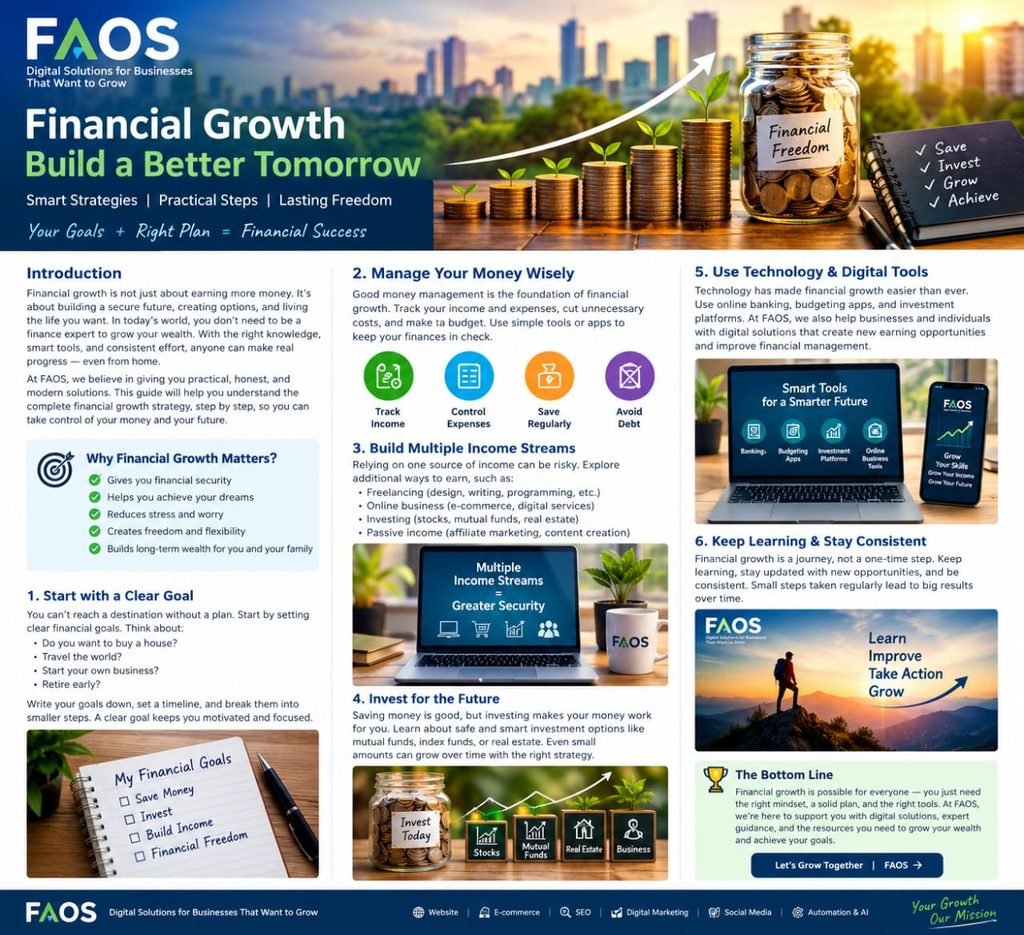
Financial Growth Is More Than Earning Money
Almost everyone wants a better financial future. Some people want to support their families, some want to start a business, and others simply want to stop worrying about bills and unexpected expenses.
But financial growth does not happen just because we earn more money. It comes from understanding our finances, making better decisions, developing useful skills, and building habits that support our goals.
You might have a small business, a full-time job, a freelance profile, or an idea you have wanted to turn into a real source of income. Wherever you are today, you can start taking practical steps towards a stronger financial future.
At FAOS, we believe technology, digital skills, and the right business strategy can help people and businesses discover new opportunities. However, real progress requires more than tools alone. It requires patience, planning, consistent effort, and a willingness to learn.
This guide explains how to approach financial growth step by step, from managing your current income to exploring new earning opportunities and planning for the future.
- Understand Your Current Financial Situation
Before making a financial plan, understand where you stand today.
Many people work hard every month but still feel that their money disappears too quickly. They may not know exactly how much they spend on daily expenses, subscriptions, transport, business costs, or unnecessary purchases.
The first step is to write everything down.
Start by identifying:
- Your monthly income from all sources.
- Your essential household and business expenses.
- Any outstanding debts or regular repayments.
- Your current savings.
- Your financial responsibilities and future goals.
You do not need expensive software to begin. A notebook, spreadsheet, or basic budgeting application is enough.
Once you understand your financial position, you can identify where improvements are possible.
For example, if you earn £2,000 per month but regularly spend almost all of it, increasing your income may help, but understanding your spending habits is equally important. The same principle applies whether you earn in pounds, dollars, rupees, or another currency.
The goal is not to judge your past decisions. It is to make better decisions from today onwards.
- Set Clear and Realistic Financial Goals
A financial goal gives your efforts direction.
Without a clear target, it is easy to spend money without considering what you want to achieve in the future.
Your goals might include:
- Building an emergency fund.
- Paying off expensive debt.
- Buying a home or vehicle.
- Starting or expanding a business.
- Learning a skill that increases your earning potential.
- Saving for education, travel, or retirement.
Divide your goals into three categories.
Short-term goals: Things you want to achieve within the next 12 months, such as saving for equipment or paying a particular bill.
Medium-term goals: Plans that may take one to five years, such as expanding a business, building substantial savings, or completing professional training.
Long-term goals: Bigger objectives that may take five years or more, such as retirement planning, long-term investments, or building a sustainable business.
Write down the amount you need, your target date, and the steps required to reach it.
Make your goals realistic. A plan you can follow consistently is usually more useful than an ambitious target that leaves you feeling overwhelmed.
- Manage Your Money Wisely
Financial growth is not only about increasing income. It is also about making the best possible use of the money you already earn.
Start by separating essential expenses from optional spending.
Essential expenses might include housing, food, utilities, transport, healthcare, and necessary business costs. Optional spending may include purchases or subscriptions that are not particularly important to your current priorities.
This does not mean you must stop enjoying life. It means deciding where your money can do the most good.
A simple monthly budget can include:
- Essential living and business expenses.
- Debt repayments.
- Emergency savings.
- Education and skill development.
- Long-term savings and investments, where appropriate.
- Personal spending.
You can begin with small changes. Review recurring subscriptions, compare service prices, plan purchases, and avoid spending simply because something is advertised as a limited-time offer.
For business owners, it is particularly important to separate business finances from personal finances. Track sales, operating costs, taxes, and actual profit rather than judging success by revenue alone.
A business that generates high sales but has uncontrolled expenses may still struggle financially.
- Build an Emergency Fund
Unexpected expenses can interrupt even the best financial plan.
A vehicle may need repairs, a customer may delay payment, or a business may experience a quiet month. Without savings, these situations can lead to expensive borrowing or unnecessary stress.
An emergency fund provides a financial cushion.
Start with a small, achievable target. You might aim to save enough to cover one unexpected expense, then gradually build towards several months of essential living costs.
The right amount depends on your responsibilities, income stability, family needs, and business circumstances.
Keep emergency money somewhere reasonably accessible and separate from everyday spending. Avoid treating it as money available for routine purchases.
If you are currently managing debt or struggling to cover essential expenses, begin with a realistic amount you can afford and consider which financial obligations need priority attention.
Building financial security is a gradual process. Even a modest reserve can give you more options when something unexpected happens.
- Increase Your Income Through Skills and Digital Opportunities
For many people, reducing expenses alone will not be enough to achieve their financial goals. They may also need to increase their earning potential.
One practical way to do this is to develop skills that solve real problems for individuals and businesses.
Digital technology has created opportunities for people to work with clients beyond their immediate location. Depending on your skills, experience, equipment, and market demand, you may be able to offer services online or develop a digital business.
Examples include:
- Website design and development.
- E-commerce store setup and management.
- Search engine optimisation (SEO).
- Digital marketing and social media management.
- Graphic design and content creation.
- Virtual assistance and administrative support.
- Business documentation and CV writing.
- AI-assisted workflows and business automation.
- Customer relationship management (CRM) setup.
- Online consulting or professional services.
You do not need to learn everything at once.
Choose one area that matches your interests and abilities. Learn the fundamentals, practise with realistic projects, build a small portfolio, and begin approaching potential customers.
For example, a person learning website development could create a sample website for a local shop. Someone interested in virtual assistance could practise managing calendars, organising documents, and preparing professional reports.
These projects help demonstrate your abilities to potential clients.
The important point is that earning money online is not automatic. It requires a useful service, customer trust, reliable delivery, and ongoing improvement.
- Create Multiple Income Opportunities Carefully
Depending on a single source of income can create financial pressure when that source becomes unstable.
A salaried employee may explore freelance work. A business owner may introduce an additional service. A skilled professional may create educational resources or offer consulting.
The right approach depends on your circumstances.
Consider these possibilities:
Freelancing: Offer a skill to clients through professional networks, direct outreach, or freelance marketplaces.
Digital services: Provide website management, SEO, online marketing, automation, or administrative support to businesses.
E-commerce: Sell products online after researching demand, costs, delivery requirements, returns, and customer expectations.
Educational content: Develop useful articles, tutorials, templates, or courses. Income is possible, but usually depends on audience trust, quality, distribution, and a clear business model.
Business partnerships: Work with complementary service providers where responsibilities, payments, and expectations are agreed upon clearly.
Start with one additional income opportunity before attempting several. Too many projects can divide your attention and affect the quality of your main work.
Also calculate your real profit. Consider platform fees, software subscriptions, advertising, taxes, refunds, and the time required to deliver a service.
A second income stream is useful when it creates sustainable value rather than simply adding more work and expenses.
- Use AI and Digital Tools to Work More Efficiently
Artificial intelligence is changing how people research, organise, create, and deliver work.
When used responsibly, AI tools can help individuals and businesses save time on certain tasks and focus more attention on customer needs and business decisions.
Possible uses include:
- Researching topics and organising ideas.
- Creating first drafts of business content.
- Preparing outlines for marketing campaigns.
- Summarising information and structuring documents.
- Generating ideas for social media content.
- Assisting with customer support workflows.
- Organising repetitive administrative processes.
- Analysing suitable business data.
For example, a small business owner might use an AI assistant to prepare a first draft of a product description, then check its accuracy, improve the wording, and ensure it matches the product.
A service provider might automate a repetitive enquiry process while keeping a person available for questions that require judgement or individual attention.
However, AI does not guarantee income. It cannot replace every professional skill, and its output may contain mistakes. Important information should be checked before it is published or used to make decisions.
Protect customer information, avoid uploading confidential data to tools without appropriate safeguards, and check the terms and privacy practices of any platform you use.
The best results often come when technology supports human judgement rather than replacing it entirely.
- Save and Invest for the Future
Saving and investing serve different purposes.
Savings can help you prepare for short-term needs and emergencies. Investing is generally intended to help build wealth over longer periods, although investment values can fall as well as rise.
Before investing, consider your emergency savings, debts, financial goals, time horizon, and ability to tolerate losses.
Learn about the available options in your country. Depending on local regulations and your circumstances, these may include savings accounts, diversified funds, bonds, shares, or other regulated investment products.
Understand the risks, fees, liquidity, and tax implications before committing money.
Be especially careful with anyone promising guaranteed high returns, quick profits, or risk-free wealth. Such claims can be warning signs of fraud or unrealistic expectations.
Do not invest money needed for essential expenses simply because someone says an opportunity will disappear soon.
You do not need to make complicated investments to begin improving your financial habits. Regular saving, sensible planning, and informed decisions can provide a stronger foundation.
If you need individual investment advice, consult a suitably qualified professional familiar with the rules and products available in your jurisdiction.
- Help Your Business Grow Financially
For business owners, financial growth means creating a business that can attract customers, manage costs, deliver value, and remain sustainable.
A business may have an excellent product but still struggle if customers cannot find it, the sales process is confusing, or expenses are poorly controlled.
Start by understanding your customers.
What problems do they face? What do they need? Why might they choose your business instead of another provider?
Then consider whether your business could benefit from:
A professional website: Give customers a clear place to learn about your services, review your work, and contact you.
E-commerce: Make it easier for customers to explore and purchase suitable products online.
SEO: Improve the chances that relevant customers can discover your business through search engines.
Digital marketing: Reach a suitable audience with clear messages, measurable goals, and a realistic budget.
Social media: Build relationships, share helpful information, answer questions, and demonstrate your expertise.
Automation and CRM: Organise enquiries, track customer relationships, reduce repetitive tasks, and improve follow-up.
These tools should support a clear business strategy. A website alone does not guarantee customers, and advertising does not guarantee profit.
Measure meaningful results such as qualified enquiries, conversion rates, customer acquisition costs, repeat purchases, and net profit.
For small businesses, a carefully planned improvement to one part of the customer journey may be more valuable than investing in several tools at once.
- Build Trust Before Spending More on Marketing
Customers are more likely to consider a business when they understand what it offers and feel confident about the people behind it.
Trust is especially important online because customers cannot always meet the service provider in person.
Make your business information clear and accurate. Explain your services, prices or pricing process, delivery timelines, payment terms, refund policies, and support arrangements.
Use genuine testimonials with permission. Show authentic examples of your work and explain what customers can reasonably expect.
Respond professionally to questions and complaints. Do not promise results you cannot control.
Protect payment information and customer data. Use appropriate security measures and trusted payment providers.
If you are a new business, start by building credibility through small projects, clear communication, reliable delivery, and honest feedback.
A strong reputation can support long-term growth, while misleading claims may damage customer relationships and the business itself.
- Keep Learning and Improving
Financial growth is not a single achievement. Your circumstances, responsibilities, industry, and opportunities may change over time.
A skill that is valuable today may need updating tomorrow. A business strategy that works for one audience may not work for another.
Make learning part of your routine.
You could set aside time each week to learn about budgeting, sales, marketing, customer service, technology, or the specific skills needed in your profession.
Apply what you learn instead of collecting information without taking action.
For example, after learning about customer follow-up, improve one part of your sales process. After studying budgeting, review your spending and make one realistic adjustment.
Review your progress monthly. Identify what is working, what is not, and what needs to change.
Do not compare your financial position with someone else’s highlight reel on social media. People have different starting points, responsibilities, resources, and opportunities.
Measure progress against your own goals.
- Create a Practical 90-Day Financial Growth Plan
A simple plan can turn these ideas into manageable actions.
Days 1–30: Understand and organise
- Record your income, expenses, debts, and savings.
- Identify your most important financial goal.
- Create a realistic monthly budget.
- Review unnecessary recurring expenses.
- Choose one skill or business opportunity to explore.
Days 31–60: Build and take action
- Begin saving a manageable amount regularly.
- Follow a structured learning plan for your chosen skill.
- Complete a sample project or improve an existing service.
- Research your target customers and their needs.
- Improve one area of your business or personal workflow.
Days 61–90: Review and improve
- Review your spending and savings progress.
- Start approaching suitable potential clients if you are ready.
- Test a small, affordable business improvement.
- Track enquiries, sales, costs, and customer feedback.
- Set your next three-month goals based on what you have learned.
Your results will depend on your circumstances and the actions you take. The purpose of this plan is not to promise a specific financial outcome; it is to help you build consistent habits and make informed decisions.
How FAOS Can Support Your Growth
At FAOS, our focus is on digital solutions for businesses that want to grow.
We recognise that moving a business online can feel confusing, particularly when you are balancing customer demands, limited time, operating costs, and uncertainty about which tools are worth using.
Our services cover areas that can help businesses strengthen their digital presence and improve their operations, including:
- Website development and e-commerce.
- SEO and digital marketing.
- Social media support.
- AI solutions and business automation.
- CRM and workflow solutions.
- CV writing, documentation, and virtual assistance.
The right service depends on your current needs, available budget, and business objectives.
A new business might begin with a professional website and a clear service offer. An established business might focus on improving search visibility, organising customer enquiries, or reducing repetitive administrative work.
Our approach is to identify the problem first and then consider which digital solution may be appropriate.
Digital tools can support business growth, but results also depend on the quality of the offer, customer demand, execution, and ongoing management.
Conclusion: Your Financial Future Starts With Your Next Decision
Financial growth is not reserved for people who already have a lot of money.
It begins with understanding your current situation, setting clear goals, managing resources carefully, developing valuable skills, and taking consistent action.
You may start by saving a small amount, learning a new skill, improving your business website, or exploring a suitable source of additional income.
The first step does not have to be perfect. It needs to be practical.
Over time, thoughtful decisions can help you create more financial stability, improve your options, and work towards the future you want.
At FAOS, we believe growth starts when people combine knowledge, useful technology, and purposeful action.
Start where you are. Build with what you have. Keep improving.
FAOS — Digital Solutions for Businesses That Want to Grow.
Ready to strengthen your business online? Explore the digital solutions available at FAOS and identify the next practical step for your business.