
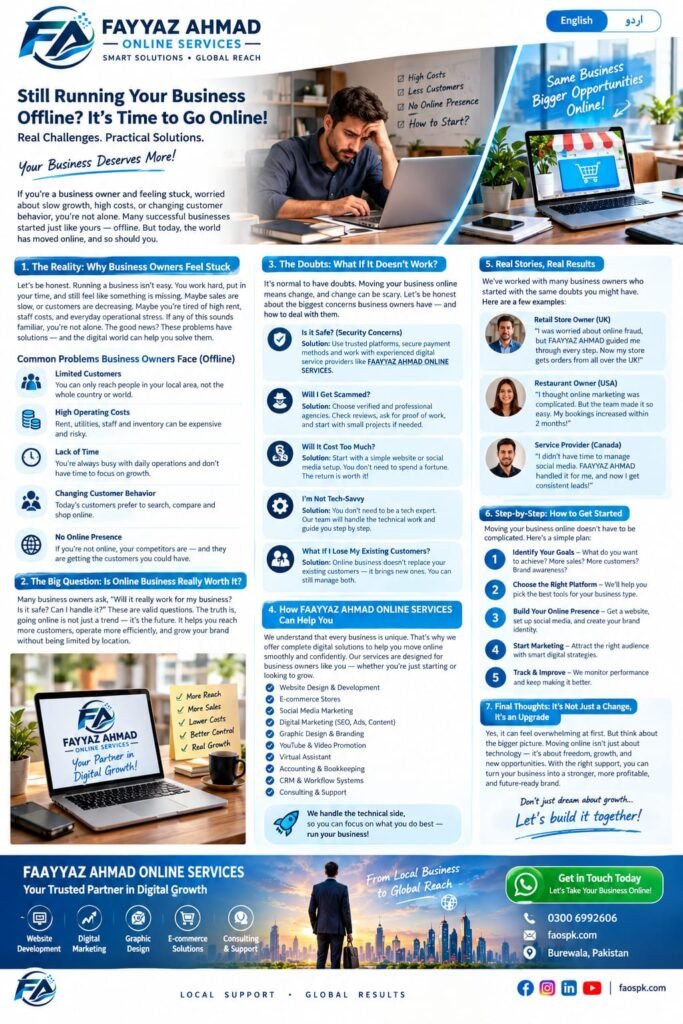
Real Business Challenges, Honest Answers, and Practical Solutions for Digital Growth
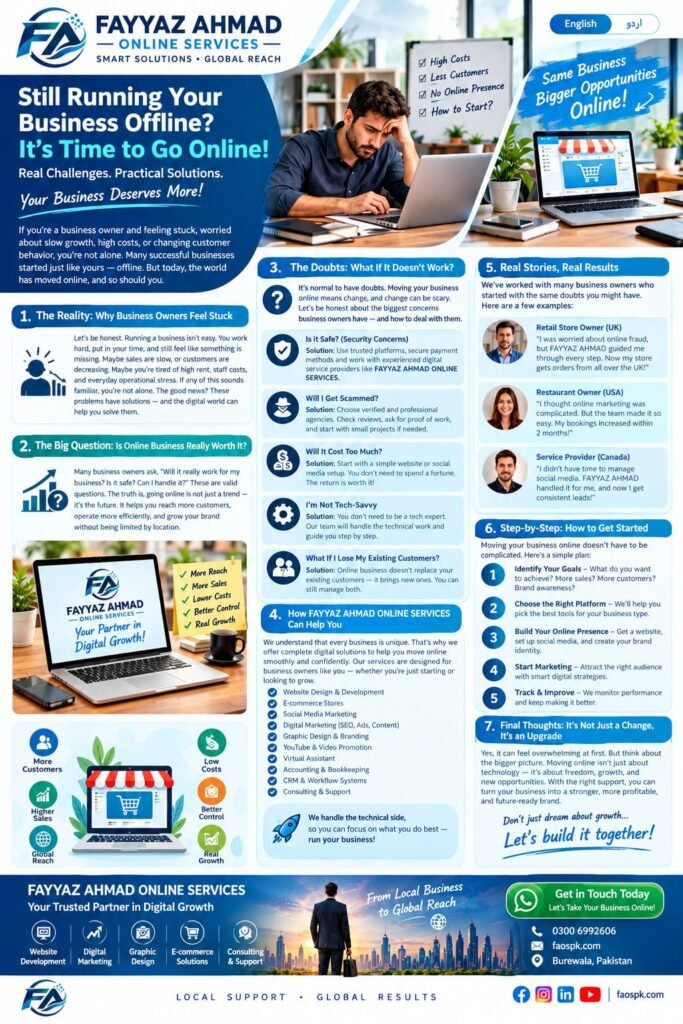
Your Business Has Potential. Is the World Able to Find It?
Imagine you have spent years building your business. You have invested your savings, worked long hours, served customers, managed employees, and done everything possible to keep things moving. Your customers know you, and your business has a place in your local market.
But something has started to change.
Customers increasingly search online before making a purchase. People compare prices on their phones, check reviews before trusting a company, and expect businesses to answer questions without making them wait too long. Even customers who eventually visit a physical shop may discover that shop through Google, Facebook, Instagram, or a website.
Meanwhile, you may be wondering how to keep up.
Perhaps your sales are not growing as quickly as you hoped. Maybe your competitors are attracting customers through social media. You might want to sell your products outside your city, but you do not know how to start. Or perhaps you have already considered hiring someone to build a website, run advertisements, or manage your social media, but you are worried about wasting money.
These concerns are completely understandable.
Running a business is already challenging. Learning unfamiliar technology, choosing the right digital services, and trusting someone with your business can feel like adding another full-time job to your responsibilities.
At Fayyaz Ahmad Online Services (FAOS), we believe moving online should not mean abandoning everything you have built. It should mean finding practical ways to strengthen it.
Your shop, office, existing customers, products, and experience still matter. Digital tools can help more people discover your business, make it easier for customers to contact you, improve your daily operations, and create opportunities beyond your immediate location.
The important thing is to take the right steps in the right order.
In this guide, we will discuss the real challenges business owners face when considering an online move, explain common fears about digital services, and explore practical ways to make the transition safer, simpler, and more manageable.
Whether you run a small shop in Pakistan, a service company in the UK, a retail business in the USA, or an established company looking for better digital systems, this article is designed to help you make an informed decision.
You do not need to understand every technical detail to build a stronger digital presence. You need a clear plan, realistic expectations, and the right support.
1. Why Are Business Owners Finding It Harder to Grow?
Every business has its own circumstances, but many owners experience similar problems.
You may have excellent products and provide good customer service, yet still struggle to reach new customers. You may be spending more on rent, salaries, stock, transportation, and utilities without seeing the growth you expected.
Sometimes, the problem is not the quality of the business. The problem is that potential customers cannot easily discover it.
Limited customer reach
A physical shop normally attracts people from its surrounding area. If your business is located in Burewala, for example, most walk-in customers may come from Burewala and nearby communities.
That local presence is valuable, but it can also limit your opportunities.
Someone in Lahore, Karachi, London, Manchester, New York, or Toronto may be interested in your products or services but have no way of discovering your business.
A website, business listing, social media presence, or online store can help close this gap.
An online presence does not automatically bring customers from every location. You still need suitable products, clear information, effective marketing, and reliable service. However, it gives people outside your immediate area a way to discover and evaluate your business.
Rising operating costs
Business expenses can increase even when sales remain unchanged.
Rent, electricity, inventory, delivery, advertising, and staffing can place pressure on profits. If customers are not increasing, managing these costs becomes even more difficult.
Digital tools can sometimes reduce unnecessary work and make existing resources more effective.
For example, an online catalogue may reduce repeated questions about product availability. A booking form can organise appointments. Automated order notifications can reduce manual follow-ups. Digital records can help you track enquiries and understand which products attract the most interest.
Not every digital service saves money immediately. A website, marketing campaign, or software subscription has its own cost. The goal is to invest where the expected benefit justifies the expense.
Too much time spent on routine tasks
Many small-business owners handle almost everything themselves.
They answer messages, prepare quotations, manage inventory, speak with suppliers, update customers, arrange deliveries, and complete administrative work.
By the end of the day, there may be little time left to plan future growth.
Simple systems can make these tasks more organised.
A business can use enquiry forms, appointment scheduling, customer relationship management software, automated reminders, and organised digital records to reduce repetitive work.
The best starting point is not necessarily a complicated system. It may be a simple process that saves you twenty minutes every day.
Changing customer expectations
Customers have become accustomed to finding information quickly.
They want to know what a business sells, where it operates, what it charges, how to contact it, and whether other customers have had a good experience.
When this information is missing, some people move on to another provider.
A clear website, accurate business profile, useful social media content, and timely responses can make it easier for customers to choose your business.
The key lesson: You do not need to become a technology company. You need to use technology in ways that solve real business problems.
2. Does Every Business Really Need to Go Online?
This is a fair question.
Not every business needs a large website, a complicated online store, or a substantial digital marketing budget. The right solution depends on what you sell, who your customers are, how you operate, and what you want to achieve.
However, most businesses can benefit from being easier to find and contact online.
If you own a local shop
A local shop may benefit from an accurate Google Business Profile, clear opening hours, location details, photographs, customer reviews, and a WhatsApp contact option.
Customers can discover the shop, check whether it offers what they need, and ask questions before visiting.
A full e-commerce website may be unnecessary at first if most sales happen in person.
If you provide professional services
Consultants, accountants, designers, repair specialists, agencies, and other service providers can use a website to explain their services, demonstrate their experience, answer common questions, and collect enquiries.
A professional website can help customers understand what you offer before arranging a meeting.
If you sell products
An online store can allow customers to explore products, compare options, place orders, and receive important updates.
You can start with a limited selection of products rather than uploading your entire inventory at once.
Payment methods, delivery arrangements, returns, and customer support should be planned according to your target market.
If you operate a traditional or family business
You do not have to change everything overnight.
You can continue serving existing customers through your usual channels while building an online presence gradually.
For example, you might begin by creating a business page, publishing useful photographs, and answering enquiries through WhatsApp. Once you understand the response, you can decide whether a website or online ordering system makes sense.
If your business already has a website
Moving online does not always mean building something new.
Your existing website may need clearer messaging, faster loading, improved mobile usability, better search visibility, simpler enquiry forms, or a more reliable checkout process.
Before spending money on a replacement, understand what is working and what needs improvement.
Going online is not about following a trend. It is about choosing the tools that help your particular business serve customers better.
3. The Biggest Fear: What If I Get Scammed?
For many business owners, this is the first concern that comes to mind.
You may have heard stories about people paying for websites that were never completed, losing access to social media accounts, receiving fake marketing reports, or spending money on advertisements without understanding where the money went.
These experiences create a reasonable question: How can I trust someone with my business?
The answer is not to trust every service provider. It is to create a process that makes trust easier to verify.
Start with clear information
Before hiring a digital service provider, understand exactly what they will deliver.
If you are paying for a website, ask how many pages are included, whether the website will work on mobile phones, whether contact forms are included, and whether you will be able to update your content.
If you are purchasing marketing services, ask which platforms will be used, what activities will be completed, how results will be measured, and how often you will receive updates.
Avoid agreements that rely entirely on vague promises such as “unlimited growth” or “guaranteed success.”
A professional provider should be able to explain the work in language you understand.
Ask for a written quotation
A written quotation helps prevent misunderstandings.
It should explain the services included, the price, the payment schedule, the expected timeline, and any additional charges that may apply.
For larger projects, ask for a written agreement covering responsibilities, revisions, delivery milestones, and ongoing support.
You should know what you are paying for before work begins.
Check previous work
Ask to see relevant examples of completed projects.
If the provider has built websites, review those websites on a phone and a computer. If they offer graphic design, look at the quality and consistency of their work. If they manage advertising, ask how they report performance.
Where possible, speak with previous clients or check independent reviews.
Remember that a portfolio is evidence of work, not proof that every future project will succeed. You should still discuss your own requirements carefully.
Keep control of your accounts
One of the most important safeguards is account ownership.
Your domain name, website hosting, business email, social media pages, advertising accounts, and customer records are valuable business assets.
Where possible, register important accounts in your own business name and keep your recovery information secure.
Give service providers the access they need to complete their work, but avoid handing over permanent ownership unnecessarily.
Use strong, unique passwords and two-factor authentication. Never share verification codes with someone who contacts you unexpectedly.
Agree on payment milestones
For a substantial project, a milestone-based payment arrangement may reduce risk.
For example, a website project could have an agreed initial payment, a payment after an approved design stage, and a final payment linked to the agreed delivery stage.
The exact arrangement depends on the project and provider.
Avoid paying a large amount without a clear scope of work, written terms, and a reliable way to verify progress.
What this means for FAOS
At Fayyaz Ahmad Online Services, the goal is to make digital work understandable and manageable for business owners.
We encourage customers to discuss their requirements, budget, priorities, and concerns before choosing a service.
The most appropriate solution is not necessarily the most expensive one. It is the one that addresses the business problem, fits the available resources, and has clear expectations.
Trust should be built through communication, transparency, evidence, and accountability—not pressure or promises.
4. Will an Online Business Actually Make Money?
This is another important question, and the honest answer is that no website, advertisement, or social media account can guarantee sales.
Online business is a real business. It still requires suitable products or services, competitive pricing, customer trust, effective communication, and reliable delivery.
Digital tools can create opportunities, but the results depend on how they are used.
Why some online businesses struggle
A business might invest in a website but receive very little traffic.
Another might attract visitors but fail to convert them into enquiries or purchases.
A third might generate orders but lose customers because deliveries are delayed or questions remain unanswered.
These situations show why having a website alone is not a complete growth strategy.
A successful digital plan needs to consider the entire customer journey.
Think about the customer journey
Imagine someone searching online for a product you sell.
First, they need to discover your business. They might find you through a search engine, social media post, advertisement, recommendation, or online marketplace.
Next, they need to understand your offer. Clear photographs, accurate descriptions, transparent prices, and useful information help them decide whether your product is relevant.
Then, they need a simple way to take the next step. That might mean sending a message, requesting a quotation, booking an appointment, or placing an order.
Finally, they need a reliable experience after contacting you. Prompt communication, clear terms, and dependable service encourage repeat purchases and recommendations.
Every stage matters.
Set realistic targets
Rather than expecting hundreds of sales immediately, establish measurable goals.
Your first goal might be to improve the number of relevant enquiries. Your next goal might be to increase completed orders or reduce the time spent answering routine questions.
You can then examine the results and make improvements.
For example, if a campaign generates many enquiries but few sales, the issue might be the audience, pricing, product information, response time, or checkout process.
The correct response is to investigate the problem rather than automatically spend more money.
Understand the difference between revenue and profit
Revenue is the money your business receives from sales. Profit is what remains after relevant expenses are deducted.
A business can generate more orders and still struggle financially if delivery costs, advertising expenses, returns, or product costs are too high.
Before investing in digital marketing, understand the approximate profit available from each sale and the cost of acquiring a customer.
This makes it easier to decide whether a campaign is financially sensible.
The goal is not simply to sell more. It is to build a business that can attract customers and serve them profitably.
5. I Do Not Understand Technology. Can I Still Move Online?
Absolutely.
Many successful business owners are experts in their industries rather than in technology.
A clothing retailer does not need to become a web developer. A restaurant owner does not need to learn programming to display a menu online. A consultant does not need to understand every advertising setting to build a professional presence.
You need to understand enough to make informed decisions and manage your business confidently.
Choose tools that match your experience
If you are new to digital business, start with a simple setup.
This might include:
A professional business profile.
A clear way for customers to contact you.
A basic website or landing page.
A small collection of useful photographs and posts.
An organised method for recording enquiries.
A reliable process for responding to customers.
As your needs grow, you can introduce additional tools.
Ask for explanations in plain English
A good service provider should be willing to explain technical decisions without making you feel uncomfortable.
You should be able to ask what a service does, why it is necessary, what it costs, and what alternatives are available.
If you do not understand an explanation, ask for a simpler one.
You are the business owner. You should remain involved in decisions that affect your budget, reputation, customers, and future plans.
Request a handover
When a website or digital system is completed, ask for a basic handover.
This might include login information, instructions for updating content, information about hosting and renewals, and guidance on contacting support.
If ongoing assistance is included in your agreement, understand its scope and limitations.
The aim should be to help you use the system, not make you permanently dependent on a provider for every small change.
Learn gradually
You do not need to master everything in one week.
Start with the activities that directly support your business goals. Learn how to review enquiries, check basic performance reports, publish simple updates, and protect your accounts.
Over time, these skills can help you make better decisions about your digital presence.
At FAOS, we believe technology should make business easier to manage—not create another source of unnecessary stress.
6. Will My Existing Customers Disappear If I Go Online?
Moving online does not mean leaving your current customers behind.
In many cases, your existing customer relationships are among your most valuable business assets. They already know your products, understand your service, and may be willing to recommend you to others.
Digital tools can help you maintain those relationships.
Keep serving customers through familiar channels
If your customers prefer visiting your shop or contacting you by phone, you can continue offering those options.
An online presence gives them additional ways to find information and contact you.
For example, a customer might discover your product on Instagram, ask a question through WhatsApp, and then visit your physical shop to complete the purchase.
Another customer might prefer to browse your website before calling.
Both journeys can work together.
Give existing customers useful information
Your website and social media profiles can help customers find updated opening hours, product availability, service details, contact information, and answers to common questions.
You can also share announcements about new products, seasonal offers, service changes, and useful advice.
The important thing is to provide information that helps customers rather than filling every channel with constant sales messages.
Make the experience consistent
Your prices, contact details, business name, and service information should be consistent wherever customers find you.
If your website says one thing and your social media page says another, customers may become confused.
Keep your information accurate and update it when something changes.
Respect customer privacy
Do not add people to marketing lists without appropriate permission or use customer information in ways they would not reasonably expect.
Explain how customers can contact you, receive updates, or request that communications stop.
Respectful communication is an important part of building long-term relationships.
Digital growth should strengthen the relationships you already have while creating opportunities to build new ones.
7. What If Customers Do Not Trust My Business Online?
Trust is one of the biggest challenges in online commerce.
Customers cannot always inspect a product in person, meet the business owner, or immediately judge whether a service provider is reliable.
They may worry about paying for something that never arrives, receiving a product that differs from its photographs, or struggling to get a response after making a purchase.
Businesses need to take these concerns seriously.
Make your business identity clear
Customers should be able to understand who you are and how to contact you.
Provide an accurate business name, relevant contact details, a clear explanation of your services, and genuine photographs where appropriate.
For service businesses, explain your process and the type of work you undertake.
For online stores, provide clear product descriptions and accurate information about delivery, returns, and customer support.
Use genuine customer feedback
Reviews can help potential customers understand what working with your business is like.
Ask satisfied customers whether they would be willing to share honest feedback.
Do not invent testimonials, purchase fake reviews, or present an individual experience as a guaranteed result.
If a customer raises a legitimate concern, respond professionally and explain how you intend to address it.
A thoughtful response to a problem can demonstrate responsibility more effectively than pretending problems never occur.
Explain payment and delivery arrangements
Before customers commit to a purchase, make the relevant terms easy to understand.
Explain which payment methods are accepted, whether delivery charges apply, what the expected delivery period is, and how customers can request help.
For international customers, clarify currency, shipping arrangements, taxes or duties where relevant, and any geographic restrictions.
Never promise delivery dates or payment protections that you cannot actually provide.
Protect customer information
Use reputable platforms, secure website connections, appropriate access controls, and trusted payment providers.
Collect only the information you genuinely need.
For websites that process personal data, publish an appropriate privacy policy and follow the laws that apply to your business and customers.
No online system is completely free from risk, but responsible security practices can reduce avoidable problems.
Be honest about what you can deliver
Do not advertise products you cannot supply or services you cannot realistically provide.
If an item is unavailable, explain the situation. If a delivery is delayed, communicate with the customer.
If a service requires more time than expected, discuss the revised timeline.
Honesty may not eliminate every complaint, but it gives customers a reason to take your business seriously.
8. How Much Does It Cost to Move a Business Online?
There is no single price that suits every business.
A simple online presence has different requirements from a large e-commerce store. A local service provider may need only a website and enquiry system, while an international retailer may require product management, shipping integrations, multiple payment methods, and customer support processes.
The right budget depends on what you need and what you can afford.
Start with your business priorities
Before requesting quotations, write down your main objective.
Do you want more local customers? Do you want to sell products online? Do you need a professional website? Are you trying to organise customer enquiries? Do you want to reach customers in another country?
Clear priorities help prevent unnecessary spending.
Understand the main cost categories
Depending on your project, expenses may include:
Domain registration.
Website design and development.
Hosting and maintenance.
E-commerce functionality.
Product photography and content creation.
Marketing and advertising.
Business software and integrations.
Customer support or ongoing management.
Some costs are recurring, while others are associated with the initial setup.
Ask which expenses are included in the quotation and which will be billed separately.
You do not have to buy everything at once
A small business can begin with a basic setup and expand when there is evidence that additional investment is worthwhile.
For example, you might start with a professional website, a clear contact method, and a few well-developed service pages.
Later, you could add online payments, appointment scheduling, customer management software, or more advanced marketing.
This staged approach can help you manage risk and learn what your customers actually need.
Beware of prices that seem too good to be true
An unusually low price is not automatically a bad deal, and an expensive service is not automatically a good one.
The important questions are what is included, who owns the finished work, whether the provider has relevant experience, and what support is available.
Compare quotations on the basis of scope, quality, transparency, and suitability—not price alone.
Keep advertising budgets separate
Website development fees and advertising budgets are different expenses.
If you hire a provider to manage paid advertising, clarify the management fee and the amount paid to the advertising platform.
Ask how spending will be monitored and how performance will be reported.
Set a budget that your business can afford to test without putting essential operating expenses at risk.
A sensible digital investment should fit your business today while leaving room for future growth.
9. Website, Social Media, or Online Store: What Should You Choose?
Business owners sometimes feel overwhelmed because there are so many digital options.
The answer is not to use every platform. It is to select the channels that best support your customers and objectives.
A professional website
A website gives your business a place to explain what it does, display services or products, answer questions, and collect enquiries.
Unlike a social media profile, a website can give you greater control over the structure of your information and the customer experience.
However, building a website does not automatically bring visitors. It needs useful content, appropriate promotion, and ongoing attention.
Social media
Platforms such as Facebook and Instagram can help businesses share photographs, updates, educational content, offers, and customer stories.
They can be particularly useful for businesses whose products or services are easy to demonstrate visually.
Social media can also help businesses communicate with customers, but relying entirely on one platform has risks. Accounts can be restricted, platform rules can change, and organic reach can fluctuate.
Keep control of your accounts and consider maintaining a website or another reliable channel for important business information.
E-commerce
An online store can be useful when customers need to browse products, select options, place orders, or make payments online.
It may also help businesses organise product information and order processing.
Before launching, plan inventory management, delivery, customer service, payment arrangements, returns, and order updates.
A store that looks attractive but cannot fulfil orders reliably will struggle to maintain customer trust.
WhatsApp Business
WhatsApp Business can provide a familiar way for customers to ask questions, discuss requirements, and receive updates.
Depending on your setup, you may use business information, product catalogues, labels, and automated greetings or away messages.
It can be especially useful for businesses that already receive enquiries through messaging.
However, a messaging account should not become an excuse for disorganised communication. Establish a process for responding to enquiries and keeping customer information appropriately protected.
Search engine optimisation
Search engine optimisation, commonly called SEO, helps make website content easier for search engines to understand and potentially show to relevant users.
Useful SEO work includes researching customer questions, writing clear service pages, improving website structure, ensuring mobile usability, and making business information accurate.
SEO takes time, and rankings are not guaranteed. Avoid providers who promise a specific position on Google without acknowledging the uncertainty involved.
The best combination
For many small businesses, a practical starting combination is a website, a relevant social media presence, and a clear contact method.
Other businesses may need an online store, booking system, or customer management platform.
Choose based on your goals, audience, and resources.
10. How Can Your Business Reach Customers in the USA and UK?
International growth can be attractive, especially for businesses with products or services that can be delivered across borders.
However, reaching customers in another country requires more than translating a website or publishing a few social media posts.
You need to understand your target market and whether your business can serve it reliably.
Understand your target audience
Customers in different markets may have different expectations, purchasing habits, budgets, and preferred communication methods.
Research the specific audience you want to reach.
For example, a business targeting small companies in the UK may need to explain its service process, pricing, and support arrangements differently from a business targeting retail customers in the USA.
Avoid assuming that every customer in a country behaves the same way.
Use clear, natural English
Your website should communicate in language that your audience understands.
Simple, direct English is often more effective than complicated business terminology.
Explain what you offer, who it helps, how it works, and what the customer should do next.
Avoid exaggerated claims, awkward translations, and promises that cannot be verified.
A professional tone does not require complicated vocabulary.
Make pricing understandable
International customers need to understand the cost of your service or product.
Where relevant, clarify the currency, payment arrangements, delivery charges, taxes, and other potential expenses.
If prices depend on the project, explain how customers can request a quotation.
Do not display a price in a foreign currency unless you understand how the amount will be charged and whether exchange-rate changes may apply.
Address international customer concerns
Customers may want to know where your business is based, how communication will work across time zones, what support is available, and how disagreements will be handled.
Provide accurate information.
If your business operates from Pakistan and serves overseas clients remotely, explain that arrangement confidently. You do not need to pretend to have a physical office in a country where you do not operate.
What matters is whether you can deliver the agreed service professionally.
Understand legal and operational requirements
Depending on your business model, international sales may involve privacy laws, consumer protection rules, tax obligations, customs requirements, intellectual property rights, or restrictions on particular products and services.
Research the requirements that apply to your situation and seek qualified advice where necessary.
International opportunities can be valuable, but responsible preparation matters.
11. Digital Marketing: Why Posting More Is Not Always the Answer
Many businesses believe that publishing more posts automatically leads to more customers.
Unfortunately, quantity alone does not guarantee results.
A business can publish every day and still struggle if the content does not reach the right audience or give people a reason to take action.
Start with useful content
Think about the questions customers ask before buying.
They may want to understand how a product works, which option suits their needs, how a service is delivered, or what they should consider before making a decision.
Create content that answers those questions.
A clothing business might explain how to choose the right size. A service provider might describe its process. A retailer might demonstrate how to use a product correctly.
Useful information can help potential customers understand your business and decide whether it is right for them.
Make every post serve a purpose
Before publishing, ask what the content is intended to achieve.
Is it designed to introduce the business, answer a common question, demonstrate a product, explain a service, or encourage a relevant enquiry?
A clear purpose makes content easier to plan and evaluate.
Do not confuse engagement with sales
Likes, views, and comments can provide useful signals, but they do not always translate into revenue.
Pay attention to enquiries, qualified leads, completed purchases, repeat customers, and the cost of generating results.
The right measurements depend on your business model.
Use paid advertising carefully
Paid advertising can help businesses reach selected audiences, but campaigns require planning and monitoring.
Start by defining your audience, offer, budget, and desired outcome.
Test your message and landing page. Review results regularly and make changes when the evidence suggests something is not working.
Do not continue spending simply because you have already invested money.
Build consistency rather than chasing every trend
A sustainable content plan is more useful than an ambitious schedule you cannot maintain.
Choose a manageable publishing frequency and focus on quality, relevance, and accurate information.
Your business does not need to participate in every viral trend to establish a professional online presence.
12. Search Engine Optimisation: Helping Customers Find You
Imagine a potential customer searches online for a service your company provides.
If your website does not clearly explain what you offer, where you operate, or which problems you solve, search engines and visitors may struggle to understand whether your business is relevant.
SEO helps improve that understanding.
Create pages around real customer needs
Instead of writing only about your company, create useful pages that answer the questions your customers actually ask.
A web design company might explain website costs, the difference between a basic website and an online store, and what information is needed before a project begins.
A local service business might create a page explaining its services, operating area, and process.
Each page should provide meaningful information rather than repeating keywords unnecessarily.
Make your website easy to use
Visitors should be able to find important information without excessive searching.
Use clear headings, readable text, helpful navigation, and visible contact details.
Make sure the website works properly on mobile devices because many visitors will use phones.
Technical performance, accessibility, and content quality all contribute to the overall experience.
Keep business information accurate
If you serve local customers, maintain accurate business information wherever your business is listed.
Where relevant, update your address, contact details, hours, and service areas.
Do not create misleading listings or claim locations where you do not genuinely operate.
Be patient with results
SEO is not an instant solution.
The time required depends on competition, website condition, content quality, market demand, and many other factors.
A responsible provider should explain the work being performed and report meaningful progress without promising guaranteed rankings.
The objective is to improve your chances of attracting relevant visitors over time.
13. What About Data Security and Online Privacy?
Security is not just a technical issue. It is a business responsibility.
Your digital systems may contain customer names, contact details, order information, invoices, business documents, and private communications.
Losing access to these records or exposing them improperly can damage customer trust and disrupt operations.
Protect your accounts
Use unique passwords for important accounts and enable two-factor authentication wherever possible.
Avoid sharing passwords through unsecured messages.
When working with a digital agency or freelancer, provide appropriate access rather than automatically sharing the primary account credentials.
Remove access when it is no longer needed.
Back up important information
Your business should have a practical plan for recovering important information if a device fails, an account is compromised, or a website develops a problem.
Depending on your setup, this may include website backups, copies of essential documents, and secure storage of business records.
Test recovery procedures when appropriate. A backup is only useful if you can restore the information you need.
Collect less information
Do not collect personal information simply because a form allows you to do so.
Ask only for details necessary to provide the service, complete the transaction, or meet a legitimate requirement.
Explain how customer information will be used and retained, and apply appropriate safeguards.
Recognise suspicious messages
Be cautious of unexpected messages claiming that an account will be closed unless you click a link or provide verification details.
Check requests through official channels rather than relying on the message itself.
Never share one-time security codes with someone who claims to need them to protect your account.
Make security part of the plan
Security should not be treated as an optional extra added only after something goes wrong.
When choosing websites, payment systems, business software, and service providers, consider how accounts, information, backups, and access will be managed.
14. How Digital Tools Can Reduce Everyday Business Pressure
Online business is not only about attracting new customers. It can also help you manage the customers and operations you already have.
Many business owners lose valuable time because information is scattered across notebooks, spreadsheets, emails, messaging apps, and individual employees’ devices.
A well-designed digital process can make everyday work more organised.
Customer relationship management
Customer relationship management software, often called CRM, helps businesses organise information about prospects and customers.
Depending on the system, it may record enquiries, contact history, follow-up dates, sales stages, and customer preferences.
This can help a business identify which enquiries need attention and reduce the risk of forgetting important follow-ups.
Start with a simple system that suits the size of your operation. More features are not always better.
Workflow automation
Automation can handle selected repetitive tasks.
For example, a system might send an appointment confirmation, notify a team member when an enquiry arrives, or create a reminder when a customer needs a follow-up.
Automation should support a clear process rather than reproduce a confusing one.
Before automating a task, understand how it currently works and what should happen when something goes wrong.
Accounting and bookkeeping
Digital accounting tools can help businesses organise invoices, expenses, payments, and financial records.
They may also make it easier to review outstanding invoices and prepare information for an accountant.
The appropriate system depends on your business requirements, local regulations, and reporting needs.
Software does not remove the need for accurate records or qualified financial advice.
AI and chatbot solutions
Artificial intelligence can support selected customer service and administrative tasks.
For example, an AI assistant may help answer routine questions, organise information, draft content, or direct enquiries to the appropriate person.
However, automated systems can misunderstand questions or provide incorrect information.
For important decisions, sensitive information, complaints, or unusual requests, customers should have a clear way to reach a human representative.
Automation should improve service, not make customers feel trapped in an endless conversation with a machine.
Virtual assistance
A virtual assistant may help with administrative tasks such as scheduling, organising documents, updating records, preparing reports, or managing agreed communication activities.
Before outsourcing, define responsibilities, deadlines, access permissions, and confidentiality expectations.
The purpose is to free up your time for activities that genuinely require your attention.
15. What If My Business Is Too Small for Digital Services?
Small businesses often assume digital transformation is something only large companies can afford.
In reality, the appropriate starting point for a small business may be relatively simple.
A local repair service, independent retailer, home-based business, consultant, or small family company may need only a few well-chosen tools.
Begin with one important problem
Perhaps customers struggle to find your opening hours.
Perhaps people regularly ask for the same product information.
Perhaps you lose enquiries because you forget to respond.
Perhaps customers cannot understand the services you provide.
Choose the problem that creates the greatest practical difficulty.
Then identify the simplest affordable solution.
Build on what already works
If customers already contact you through WhatsApp, organise that process before introducing another messaging platform.
If your social media page generates genuine enquiries, improve the information and customer response process before paying for a completely new marketing system.
If your business already has a useful website, investigate whether improvements are more appropriate than a full redesign.
Digital transformation does not require replacing every existing tool.
Expand when the need becomes clear
As your business grows, you may need additional functionality.
You might add a booking system, online payments, inventory tracking, a larger website, or more advanced marketing.
Make these decisions when you understand the problem they will solve.
This approach allows your digital presence to develop alongside your business rather than becoming an unnecessary financial burden.
16. How to Choose the Right Digital Service Provider
Choosing a provider is an important business decision.
The person or company you hire may influence your website, brand image, advertising expenditure, customer experience, and access to valuable information.
Taking time to evaluate your options can help prevent misunderstandings.
Look for relevant experience
Ask whether the provider has worked on projects similar to yours.
A business that needs a local service website may have very different requirements from a retailer managing hundreds of products.
Relevant experience can help the provider understand your challenges and suggest suitable solutions.
Evaluate communication
Pay attention to how the provider responds to your questions.
Do they explain things clearly? Do they listen to your requirements? Do they acknowledge limitations? Are they willing to discuss costs and timelines openly?
Good communication is particularly important when you are not familiar with technical work.
Ask who will do the work
Clarify whether the provider will complete the work directly or involve other freelancers or subcontractors.
If other people will have access to your systems or customer information, understand how that access will be managed.
Understand revisions and support
Find out how many revisions are included, what happens if requirements change, and whether support continues after delivery.
A website may require future updates, security maintenance, hosting renewals, or additional functionality.
Understand which services are included and which require a separate agreement.
Keep realistic expectations
A professional provider should not promise that a new website will automatically put you at the top of Google, double your revenue, or make your business successful overnight.
They should help you understand what can reasonably be delivered, what depends on external factors, and how progress will be evaluated.
At FAOS, our approach is to focus on understanding the customer’s needs first and identifying suitable digital solutions second.
The purpose is to help business owners make informed decisions rather than feel pressured into buying services they do not need.
17. How Fayyaz Ahmad Online Services Can Help Your Business
Every business has different goals, customers, and operating challenges.
Some need a professional website. Others need a better marketing strategy, an online store, help with business administration, or systems that make daily work easier.
Fayyaz Ahmad Online Services offers a range of local and global services intended to support businesses at different stages of their digital journey.
The most appropriate combination depends on your requirements.
Website design and development
A professional website can help customers understand your business, explore your services, and contact you.
Our website services can be considered by businesses that need a new online presence or want to improve an existing website.
The project scope should be agreed in advance, including the required pages, functionality, design direction, and ongoing support arrangements.
WordPress websites
WordPress can provide a flexible platform for business websites, blogs, service pages, and certain e-commerce projects.
The right setup depends on the features you need, the content you want to manage, and the maintenance your business can support.
E-commerce solutions
For businesses that want to sell products online, an e-commerce store can provide a structured way to present products and manage orders.
Planning should include product information, payment options, delivery, customer communication, and returns.
Social media marketing
Social media services can help businesses plan and publish relevant content, maintain a consistent brand presence, and communicate with their audience.
The strategy should be based on the customers you want to reach and the objectives you want to achieve.
Digital marketing and paid advertising
Digital marketing can help businesses attract relevant visitors and enquiries through suitable online channels.
Depending on the project, this may involve advertising, content, campaign planning, and performance reporting.
Advertising budgets and management fees should be clearly distinguished.
Search engine optimisation
SEO services can help improve website structure, content relevance, and search visibility.
The objective is to make your business easier for relevant customers to discover, while recognising that rankings and traffic cannot be guaranteed.
Graphic design and branding
Consistent visual branding can help customers recognise your business and understand your message.
This may include suitable designs for digital platforms, marketing materials, business graphics, and other agreed brand assets.
YouTube and video promotion
Video can help businesses demonstrate products, explain services, answer common questions, and share useful information.
A video strategy should consider the intended audience, content quality, production requirements, and how viewers will be encouraged to take the next step.
Virtual assistance
Businesses that need administrative support may benefit from help with agreed tasks such as document organisation, scheduling, data entry, or routine business coordination.
Responsibilities, deadlines, confidentiality, and access permissions should be established clearly.
Accounting and bookkeeping support
Businesses may need assistance organising financial records and routine bookkeeping activities.
The precise scope should be defined according to the service offered and the applicable professional and regulatory requirements.
Specialist tax, audit, and financial advice should be handled by appropriately qualified professionals where required.
AI and chatbot solutions
AI-assisted tools can support routine enquiries, information management, and selected administrative processes.
The right approach should include suitable testing, human oversight, privacy safeguards, and a way for customers to obtain human assistance when necessary.
Business automation and CRM systems
Automation and customer management tools can help businesses organise workflows, follow up on enquiries, and manage customer information more consistently.
The goal is to reduce unnecessary manual work while keeping the process understandable and manageable.
Consulting and support
Sometimes, the first step is simply understanding what your business needs.
A discussion about your current setup, priorities, budget, and challenges can help identify suitable next steps.
You do not need to commit to a large project before understanding your options.
FAOS aims to help businesses choose practical digital solutions that fit their needs, rather than encouraging unnecessary complexity.
18. Moving Online Without Losing Your Business Identity
One concern business owners sometimes express is that online transformation will make their business feel unfamiliar or impersonal.
They may have spent years building personal relationships with customers and do not want to replace that experience with automated messages and generic marketing.
That concern is understandable.
Digital tools work best when they support the qualities that make a business valuable in the first place.
Keep your personality
Your online content should reflect your actual business.
If your company is known for personal service, show how customers can receive that service online.
If you specialise in a particular product, explain what makes your approach useful.
If your business is built on long-term relationships, communicate in a way that feels respectful and genuine.
Use real information
Share accurate photographs, genuine business details, and clear explanations.
Avoid pretending to be a larger company than you are or creating a misleading impression of your experience.
Customers appreciate knowing what to expect.
Make it easy to speak to a person
Digital convenience should not eliminate personal communication.
Give customers a practical way to ask questions, discuss special requirements, or resolve problems.
If you use chatbots or automated messages, make their purpose clear and provide a way to reach a human when appropriate.
Protect the values that made you successful
If customers choose your business because you are reliable, helpful, knowledgeable, or attentive, keep those qualities at the centre of your digital strategy.
Technology can change how people discover and interact with your business. It should not force you to abandon the values that earned their trust.
19. A Practical 30-Day Plan for Starting Your Digital Journey
Moving online may feel like a major project, but the first month can be used to understand your needs and establish a manageable foundation.
The following plan is a starting point, not a guarantee of results. You can adjust it to fit your schedule, budget, and business model.
Week 1: Understand your current situation
Begin by reviewing your business.
Write down your main products or services, the customers you want to reach, the questions customers regularly ask, and the challenges that consume the most time.
Look at your existing website and social media profiles, if you have them.
Check whether your business information is accurate and whether customers can easily contact you.
Then select one or two priorities.
For example, your immediate priority might be attracting more local enquiries or creating a professional website that explains your services.
Avoid trying to solve every problem at once.
Week 2: Build the basic online presence
Choose the digital tools that support your priorities.
Depending on your needs, this may involve creating or improving a business profile, preparing a website, organising a product catalogue, or establishing a clear enquiry process.
Make sure the information is accurate and the design is easy to use on mobile devices.
Include clear contact information and explain what customers should do next.
If you are working with a service provider, agree on the scope, cost, and timeline before proceeding.
Week 3: Start communicating with your audience
Prepare useful content that introduces your business and answers common customer questions.
You might publish a service explanation, a product demonstration, a frequently asked question, or a short guide related to your industry.
Keep your message clear and relevant.
Respond to enquiries professionally and record the questions customers ask most often.
These conversations can help you improve your website and future content.
Week 4: Review and improve
At the end of the month, review what happened.
How many enquiries did you receive? Which questions appeared most frequently? Did customers find the information they needed? Were there problems with the website or communication process?
If you ran paid advertising, review the campaign’s results against your original objective and budget.
Do not judge the entire strategy on one number.
Use the information to identify improvements and decide what to do next.
What happens after the first month?
Continue improving the parts of your business that show promise.
You might strengthen your website content, introduce an online booking system, improve customer follow-ups, or test a carefully planned marketing campaign.
You may also discover that a service you initially considered is not necessary.
That is useful information too.
Progress comes from making informed decisions, learning from real results, and improving your approach over time.
20. Common Mistakes to Avoid When Taking Your Business Online
Learning what not to do can save time, money, and frustration.
Here are some common mistakes worth avoiding.
Mistake 1: Spending before defining the goal
A business might pay for a website or advertising campaign without deciding what success should look like.
Before investing, establish the problem you want to solve and how you will evaluate the outcome.
Mistake 2: Expecting instant results
Some digital activities can produce quick responses, but others take time.
A new website may need promotion. SEO may take months to develop meaningful visibility. A new brand may need time to earn customer trust.
Set realistic expectations and review progress regularly.
Mistake 3: Choosing the cheapest option without checking the details
A low price may be appropriate for a simple project, but the scope still matters.
Understand what is included, who owns the finished work, and whether essential features or support will cost extra.
Mistake 4: Giving away account ownership
Do not casually transfer ownership of valuable business accounts.
Use appropriate permissions, secure recovery details, and retain control over your important digital assets.
Mistake 5: Ignoring customer enquiries
Marketing creates little value if enquiries are left unanswered.
Establish a realistic response process and let customers know when they can expect a reply.
If you cannot respond immediately, a clear acknowledgement may help manage expectations.
Mistake 6: Copying competitors
Competitor research can help you understand the market, but copying another business’s content or visual identity is not a sustainable strategy.
Explain your own strengths, serve your own audience, and develop a recognisable brand.
Mistake 7: Ignoring customer feedback
Customers often reveal where the buying process is confusing.
Listen to recurring questions and complaints. Improve the information, service, or process where appropriate.
Mistake 8: Using fake reviews or exaggerated claims
Misleading claims can damage your reputation and may create legal or platform-related problems.
Use genuine evidence, explain limitations, and communicate honestly.
Mistake 9: Forgetting ongoing maintenance
Websites and digital systems need attention after launch.
Plan for updates, backups, security, renewals, content changes, and support according to your setup.
Mistake 10: Trying to do everything alone
Business owners do not have unlimited time.
You may be able to manage some digital tasks yourself while seeking specialist help for others.
The important thing is to identify where outside support will genuinely make a difference.
21. How to Measure Whether Your Digital Strategy Is Working
A digital strategy should not remain a collection of activities without a way to evaluate them.
The right measurements depend on your business, but a few basic indicators can help you understand progress.
Website visitors
Website traffic tells you how many visits your website receives, although the number alone does not reveal whether the visitors are relevant to your business.
Look at which pages attract attention and how visitors arrive.
Enquiries and leads
Track the number of people who contact you about your products or services.
Where practical, distinguish between general questions and enquiries that are genuinely relevant to what you offer.
Conversion rate
A conversion occurs when someone completes a desired action, such as submitting a form, booking a service, or purchasing a product.
Understanding the proportion of visitors who take that action can help you identify opportunities to improve the customer journey.
Customer acquisition cost
Customer acquisition cost estimates how much you spend to gain a customer.
The calculation should include the relevant marketing and sales expenses for the period you are measuring.
Interpret the result in relation to your profit margins and customer value.
Repeat purchases
Repeat customers can be an important sign of customer satisfaction and business stability.
Monitor repeat orders where appropriate and look for ways to improve the experience that encourages customers to return.
Response time
For service businesses, the time taken to respond to enquiries can affect the customer experience.
Track whether your process helps you respond consistently and whether certain enquiries are being missed.
Customer feedback
Reviews, complaints, direct feedback, and common questions can reveal issues that numerical reports do not show.
Use this information to improve your service.
Review the full picture
Do not judge your business solely by followers, impressions, or website traffic.
A smaller number of relevant enquiries may be more valuable than thousands of visits from people who are unlikely to become customers.
Choose measurements that connect your digital activities to meaningful business objectives.
22. A Message to Business Owners Who Are Still Unsure
Perhaps you have read this far and still have questions.
You may be worried that the technology will be difficult, that customers will not trust an online business, or that you will spend money without seeing meaningful results.
You might also be thinking that your business has survived for years without a website, so there is no reason to change now.
You do not have to ignore these concerns.
In fact, asking these questions before making an investment is a sensible business decision.
The important thing is to separate genuine risks from assumptions and address them one by one.
If you are concerned about cost, start with a clear budget and a smaller project.
If you are worried about fraud, verify the provider, agree on the scope in writing, and retain control of your accounts.
If you are unfamiliar with technology, request straightforward explanations and a proper handover.
If you are uncertain about demand, research your customers and test your approach before making a large investment.
If you already have a successful business, look for ways to strengthen it rather than replacing everything that works.
You do not need to make a dramatic change overnight.
You need to make the next sensible decision.
The future of your business should not depend on blindly following trends or trusting promises that sound too good to be true.
It should depend on understanding your customers, managing your resources carefully, and choosing tools that help you serve people better.
23. Why the Right Digital Partner Matters
When you work with a digital service provider, you are not simply purchasing a website, a logo, or a marketing campaign.
You are making decisions about how customers will experience your business.
Your website may be the first place a potential customer learns about your company. Your social media content may shape their first impression. Your online enquiry process may determine whether they contact you or move on to another provider.
That is why communication, planning, and accountability matter.
A suitable partner should take the time to understand your business before recommending a solution.
They should be willing to discuss your budget, explain the available options, identify limitations, and agree on what the project will deliver.
They should also understand that every business has different needs.
A local shop may require a simple, reliable online presence. A growing retailer may need an e-commerce system. A professional service provider may benefit from a stronger website and a better enquiry process. An established company may need help connecting several systems.
The right solution is the one that fits the problem.
At Fayyaz Ahmad Online Services, our aim is to support businesses with practical digital services, from website development and branding to marketing, automation, virtual assistance, and business support.
We understand that business owners have responsibilities beyond technology. They need to serve customers, manage costs, maintain quality, and make decisions about the future.
Digital support should help them manage those responsibilities more effectively.
We encourage business owners to ask questions, understand their options, and choose services based on clear requirements.
A good working relationship should be built on honest communication, agreed expectations, and a shared understanding of what the business is trying to achieve.
24. Frequently Asked Questions About Moving a Business Online
Can I move my business online while keeping my physical shop?
Yes. Many businesses operate online and offline at the same time. You can continue serving walk-in customers while using your website, social media, or messaging channels to attract new customers and handle enquiries.
Do I need a website if I already have a Facebook page?
Not every business needs a website immediately, but a website can provide more control over your business information, content, and customer journey. The best choice depends on your goals, audience, and budget.
How long does it take to build a business website?
The timeline depends on the number of pages, design requirements, functionality, content, and availability of information. A straightforward website may take considerably less time than a complex online store. Ask your provider for a realistic project schedule.
Will my website automatically appear at the top of Google?
No. Search rankings depend on many factors, including relevance, competition, website quality, and search engine systems. A provider can work to improve your website’s SEO, but no one can responsibly guarantee a particular ranking in every situation.
Can a small business afford digital marketing?
Many small businesses can start with a limited, carefully planned approach. The appropriate budget depends on the market, objectives, competition, and the business’s ability to fulfil additional demand.
How can I tell whether a digital agency is trustworthy?
Check relevant work, ask for references where available, request a written quotation, clarify ownership and account access, agree on milestones, and avoid unrealistic promises. You should understand what you are buying before you commit.
What if I do not know how to manage my website?
Ask for a handover and basic training. Depending on your agreement, you may also arrange ongoing maintenance or support. You should understand how to access your website and where to seek help.
Can I sell products to customers in other countries?
Potentially, yes. You need to consider market demand, payment options, shipping, customs, taxes, customer service, and the legal requirements that apply to your products and target markets.
Do I need to hire a full-time employee for digital work?
Not necessarily. Depending on your needs, you may manage some tasks yourself, hire a freelancer, use an agency, or arrange virtual assistance. Compare the cost, experience, availability, and level of responsibility involved.
Is artificial intelligence suitable for every business?
No. AI can support certain tasks, but its usefulness depends on the business problem, the quality of the tools, and the risks involved. Important decisions and sensitive customer interactions may require human oversight.
How can I protect my online business from fraud?
Use strong passwords, enable two-factor authentication, retain control of important accounts, verify unexpected requests, use trusted payment providers, and establish clear agreements with service providers.
What should I do first if I want to move online?
Start by identifying the main problem you want to solve. Decide whether you need more visibility, a website, online sales, better customer communication, or more organised operations. Then choose the simplest practical next step within your budget.
25. Final Thoughts: Your Business Deserves the Opportunity to Grow
Every business begins somewhere.
Some begin with a small shop, a home office, a few products, or a skill that one person wants to share with others. Over time, owners build relationships, learn from experience, and create something valuable.
That effort deserves to be supported by tools that make it easier for customers to find and work with them.
Moving online is not a guarantee of success, and it is not a requirement to abandon traditional business methods. It is an opportunity to explore new ways of reaching customers, improving communication, organising operations, and making better use of your resources.
The best approach is practical rather than complicated.
Understand your customers. Choose the right tools. Protect your business information. Set a realistic budget. Work with people who communicate clearly. Measure your progress. Improve what needs improvement.
If you are a business owner who has been thinking about going online but does not know where to start, you do not need to have every answer before beginning.
Start with a conversation about your goals and challenges.
At Fayyaz Ahmad Online Services, we want to help businesses understand their options and identify digital solutions that fit their needs.
Whether you are starting from scratch, improving an existing website, building an online store, or looking for better ways to manage your business, the first step is understanding what would make the biggest difference.
Your business has its own story, customers, strengths, and opportunities. Your digital strategy should reflect that.
Do not move online simply because everyone else is doing it. Move online with a purpose, a plan, and a clear understanding of what you want to achieve.
Ready to Discuss Your Business’s Digital Future?
Contact Fayyaz Ahmad Online Services to discuss your requirements and explore suitable options.
Fayyaz Ahmad Online Services (FAOS)
Phone / WhatsApp: +92 300 6992606
Website: https://faospk.com
Office: Allahabad Road, Opposite Animal Mandi Gate, Burewala, Pakistan
Tell us about your business, the challenges you are facing, and what you would like to improve. We can discuss the available options and help you understand the next steps.
Your business. Your goals. Practical digital solutions.
Fayyaz Ahmad Online Services — Smart Solutions, Global Reach.
SEO Publishing Details
SEO Title:
Still Running Your Business Offline? A Practical Guide to Going Online | FAOS
Suggested URL Slug:/move-your-business-online-practical-guide/
Meta Description:
Thinking about moving your business online? Discover practical solutions to common business challenges, online scams, website costs, customer trust, digital marketing, and business growth with Fayyaz Ahmad Online Services.
Primary Keyword:
How to move your business online
Secondary Keywords:
Digital solutions for small businesses
Online business services
Website design and development
Small business digital marketing
E-commerce website development
Building customer trust online
Digital transformation for businesses
Social media marketing services
SEO services for small businesses
Business automation solutions
CRM and workflow management
Virtual assistant services
Online business support in Pakistan
Digital services for UK businesses
Digital services for US businesses
Suggested Image Alt Text:
Business owner moving from traditional operations to digital growth with website development, e-commerce, digital marketing, automation, and online business support from Fayyaz Ahmad Online Services.
Suggested Call-to-Action Button Text:
“Discuss Your Digital Business Goals”
Suggested Social Media Caption:
Still running your business offline while your customers are searching online?
You are not alone. Many business owners worry about costs, online scams, technology, and whether digital services will actually help them grow.
Our new guide explains the challenges, answers common questions, and shares practical steps for building an online presence without changing everything overnight.
Read the blog and discover how the right digital solutions can support your business.
Fayyaz Ahmad Online Services (FAOS)
Website: https://faospk.com
WhatsApp: +92 300 6992606
Smart Solutions. Global Reach.